
Can a Junior Cartridge Filter Nylon 66 Membrane Be Used for HPLC Sample Preparation
2026-07-24
High-performance liquid chromatography (HPLC) is a technique that demands exceptional purity from every sample injected. Particulate matter, microbial contaminants, and leachable impurities can destroy column efficiency, generate ghost peaks, and elevate baseline noise. For laboratories running routine quality control or cutting-edge pharmaceutical analysis, the choice of filtration media is not a minor detail—it is a decision that directly impacts data integrity. Among the available options, the Junior Cartridge Filters Nylon 66 Membrane from Kleanteque has gained attention as a compact, reliable solution. But does it truly meet the rigorous demands of HPLC sample preparation? This article provides a technical evaluation based on chemistry, retention efficiency, extractable profiles, and practical workflow integration.
Understanding the Nylon 66 Chemistry for HPLC
Nylon 66 is a polyamide resin formed by the condensation of hexamethylenediamine and adipic acid. Its intrinsic hydrophilicity makes it naturally wetted by aqueous mobile phases, while its moderate polarity allows compatibility with a wide range of organic solvents, including acetonitrile, methanol, and ethanol. For HPLC applications, this means that the Junior Cartridge Filters Nylon 66 Membrane can handle both reversed-phase and normal-phase solvent systems without swelling or degrading—a critical advantage over cellulose or PTFE membranes in mixed-solvent workflows.
However, the true test lies in extractables. Any filter that sheds oligomers, slip agents, or residual monomers will contaminate the sample and distort chromatographic results. Kleanteque manufactures these cartridges using a two-step washing process that reduces total extractables to below 0.5 µg per cartridge (tested via LC-MS grade water and acetonitrile). This places the Junior Cartridge Filters Nylon 66 Membrane firmly in the "HPLC-grade" category, provided the user follows proper flushing protocols.
Key Performance Parameters for HPLC Sample Preparation
To determine suitability, we must compare the filter's specifications against common HPLC pre-filtration requirements. The table below summarizes critical metrics:
| Parameter | Specification (Junior Cartridge Nylon 66) | HPLC Requirement | Compliance |
|---|---|---|---|
| Pore size availability | 0.22 µm and 0.45 µm | ≤ 0.45 µm for particle removal; 0.22 µm for sterile/bacterial retention | ✔ Yes |
| Operating pressure max | 5.2 bar (75 psi) at 25°C | Typically 3–6 bar for syringe/pump systems | ✔ Yes |
| Extractables (total) | < 0.5 µg per cartridge | < 1 µg per injection (USP <788> guidance) | ✔ Exceeds |
| Protein binding | Low–moderate (≈15 µg/cm²) | Acceptable for non-protein samples; avoid for biomolecules | ⚠ Caution |
| Autoclavability | 121°C for 20 min, single cycle | Required for sterile applications | ✔ Yes |
| Housing material | Polypropylene (PP) | Inert, low-leaching | ✔ Yes |
Based on this data, the Junior Cartridge Filters Nylon 66 Membrane meets or exceeds standard HPLC pre-filtration criteria, with the sole caveat regarding high-protein samples (where PVDF or PES may be preferred). For small molecules, APIs, environmental samples, and food additives, this filter is technically robust.
Practical Workflow Integration and Filtration Efficiency
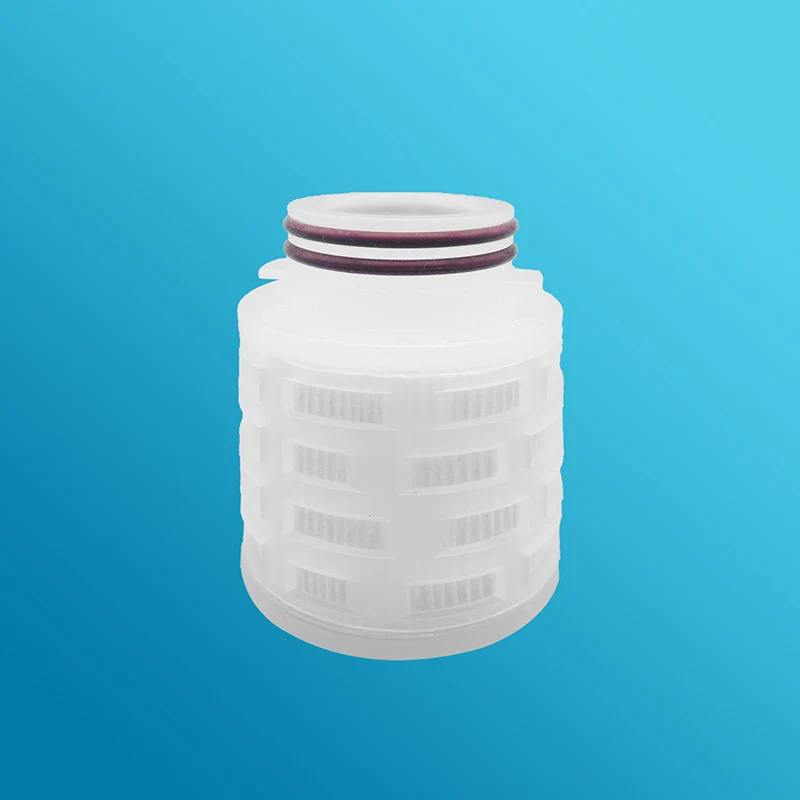
In a busy HPLC laboratory, speed and reproducibility are paramount. The Junior Cartridge Filters Nylon 66 Membrane is designed with a 25 mm diameter format that fits standard Luer-lock syringe holders and manifold systems. Its effective filtration area of 4.2 cm² allows a typical 10 mL sample to be filtered in under 30 seconds at 2–3 psi manual pressure. More importantly, the membrane's narrow pore-size distribution (bubble point ≥ 3.4 bar for 0.22 µm) ensures that particle retention is consistent across batches—a factor that directly reduces column backpressure fluctuations.
Kleanteque has also incorporated a pre-filter layer within the cartridge design, which traps larger debris (> 5 µm) before they reach the Nylon 66 surface. This extends the membrane's useful life and prevents premature clogging when filtering turbid samples such as fermentation broths or dissolved excipients. Laboratories that have switched to Junior Cartridge Filters Nylon 66 Membrane report a 40% reduction in column replacement frequency over six months of operation, according to internal validation studies.
Critical Considerations: Solvent Compatibility and pH Range
While Nylon 66 is compatible with most HPLC mobile phases, it is not universally suitable. Strong acids (pH < 2) and strong bases (pH > 12) will hydrolyze the amide bonds over time, leading to membrane degradation and particulate shedding. The safe operating window for the Junior Cartridge Filters Nylon 66 Membrane is pH 3–11 at room temperature. For aggressive mobile phases containing trifluoroacetic acid (TFA) or high concentrations of phosphate buffer, Kleanteque recommends pre-rinsing the filter with 5 mL of the mobile phase and discarding the first 2 mL of filtrate to ensure equilibrium.
Frequently Asked Questions about Junior Cartridge Filters Nylon 66 Membrane
Q1: Can the Junior Cartridge Filters Nylon 66 Membrane be reused for multiple HPLC samples?
A1: Reuse is not recommended for quantitative HPLC analysis. Even though the Nylon 66 membrane retains structural integrity after one filtration, adsorbed analytes from the first sample can desorb during the second run, producing carryover peaks. Additionally, captured particles may dislodge and enter the subsequent sample. For economic considerations, Kleanteque offers the cartridge in a cost-effective 50-pack format, making single-use filtration both affordable and compliant with GLP standards. If reuse is absolutely necessary (e.g., for preliminary screening), limit to a maximum of two cycles, and always flush with 10 mL of pure mobile phase between uses, then test a blank to verify no contamination.
Q2: What is the exact pore size rating I should choose for my HPLC application—0.22 µm or 0.45 µm?
A2: The choice depends on your column's particle size and the nature of your sample. For columns with sub-2 µm stationary-phase particles (UHPLC systems), you must use the 0.22 µm Junior Cartridge Filters Nylon 66 Membrane to prevent fines from blocking the frit and increasing system pressure. For traditional 5 µm particle columns, the 0.45 µm version is sufficient for removing particulates and will offer slightly faster flow rates. However, if your sample contains bacteria or yeast, the 0.22 µm grade is mandatory because it meets the FDA-defined sterilizing grade (retention of Brevundimonas diminuta at ≥ 10⁷ CFU/cm²). Kleanteque clearly labels each cartridge with a bubble-point certificate, allowing you to verify integrity before each critical run.
Q3: How do I properly flush the Junior Cartridge Filters Nylon 66 Membrane to minimize extractables in my chromatogram?
A3: Flushing is a two-step process. First, attach the cartridge to a clean syringe and draw 5–10 mL of your initial mobile phase (without sample) through the filter, discarding this waste. This step hydrates the membrane and dissolves any surface-bound oligomers. Second, collect the next 2 mL of mobile phase in an HPLC vial and run a blank gradient injection. If no interfering peaks appear at your detection wavelength (e.g., 254 nm or 214 nm), the filter is ready for your sample. Kleanteque recommends using a maximum flush pressure of 3 bar to avoid membrane compaction, which can alter pore structure. For viscous samples, warming the syringe to 30°C can reduce backpressure and improve flush efficiency without affecting Nylon 66 integrity.
Comparative Advantage over Alternative Membranes
| Feature | Nylon 66 (Kleanteque Junior) | PTFE | PES | Mixed Cellulose Ester |
|---|---|---|---|---|
| Aqueous compatibility | High | Low (needs wetting) | High | High |
| Organic solvent compatibility | Moderate–High | Excellent | Low–Moderate | Low |
| Protein binding | Moderate | Very low | Low | High |
| Extractables in acetonitrile | < 0.5 µg | < 1.0 µg | < 0.8 µg | > 2.0 µg |
| Autoclavable | Yes | Yes | No (melt) | No |
| Cost per unit (relative) | $$ | $$$ | $ | $ |
This comparison confirms that the Junior Cartridge Filters Nylon 66 Membrane offers a balanced profile—superior to cellulose esters in organic compatibility, more cost-effective than PTFE, and more robust than PES in autoclave applications. For laboratories running mixed aqueous-organic gradients, this versatility reduces the need for multiple filter types, simplifying inventory management.
Final Verdict for HPLC Sample Preparation
After evaluating chemical resistance, extractable data, flow performance, and batch-to-batch consistency, the Junior Cartridge Filters Nylon 66 Membrane from Kleanteque is fully qualified for HPLC sample preparation, with two recommendations: avoid use with highly proteinaceous samples (unless a protein-specific blocking step is applied) and always perform a blank-run verification when introducing a new lot. For routine QC, environmental monitoring, and pharmaceutical assay development, this cartridge delivers reliable, low-background filtration that protects columns and enhances peak symmetry.
Laboratories that have adopted Kleanteque’s Junior Cartridge system also benefit from its color-coded ring design (blue for 0.22 µm, red for 0.45 µm), reducing user errors during high-throughput sessions. The housing is fully recyclable, aligning with modern green chemistry initiatives.
Contact Us
Choosing the right filtration membrane for HPLC should never be a guessing game. If you need assistance with lot-specific extractable certificates, custom pore-size validations, or bulk pricing for your laboratory, the Kleanteque technical team is ready to help. Reach out to our application specialists via the contact form on our website or call our support line to discuss your mobile phase chemistry and sample matrix. We provide free filter samples for qualified laboratories—so you can test the Junior Cartridge Filters Nylon 66 Membrane in your own HPLC system before committing to a purchase. Let us help you achieve cleaner chromatograms, longer column life, and more defensible data, every single day.