

Can Surface-Modified Titanate Nanotubes Powder Achieve Higher CO₂ Photoreduction Efficiency Than Pristine Ones
2026-08-21
The escalating global CO₂ concentration demands innovative catalytic solutions that operate under ambient conditions. Titanate Nanotubes Powder (TNTs) has emerged as a promising photocatalyst due to its large specific surface area, excellent ion-exchange capacity, and one-dimensional tubular architecture that facilitates charge carrier transport. However, pristine Titanate Nanotubes Powder suffers from wide bandgap limitations and rapid electron–hole recombination, which severely restrict its quantum efficiency for CO₂ photoreduction. At SAT NANO, we have systematically investigated whether surface-modified Titanate Nanotubes Powder can overcome these intrinsic drawbacks and deliver superior performance compared to its unmodified counterpart. This blog presents comparative experimental data, mechanistic insights, and practical answers to the most frequently asked questions surrounding this advanced nanomaterial.
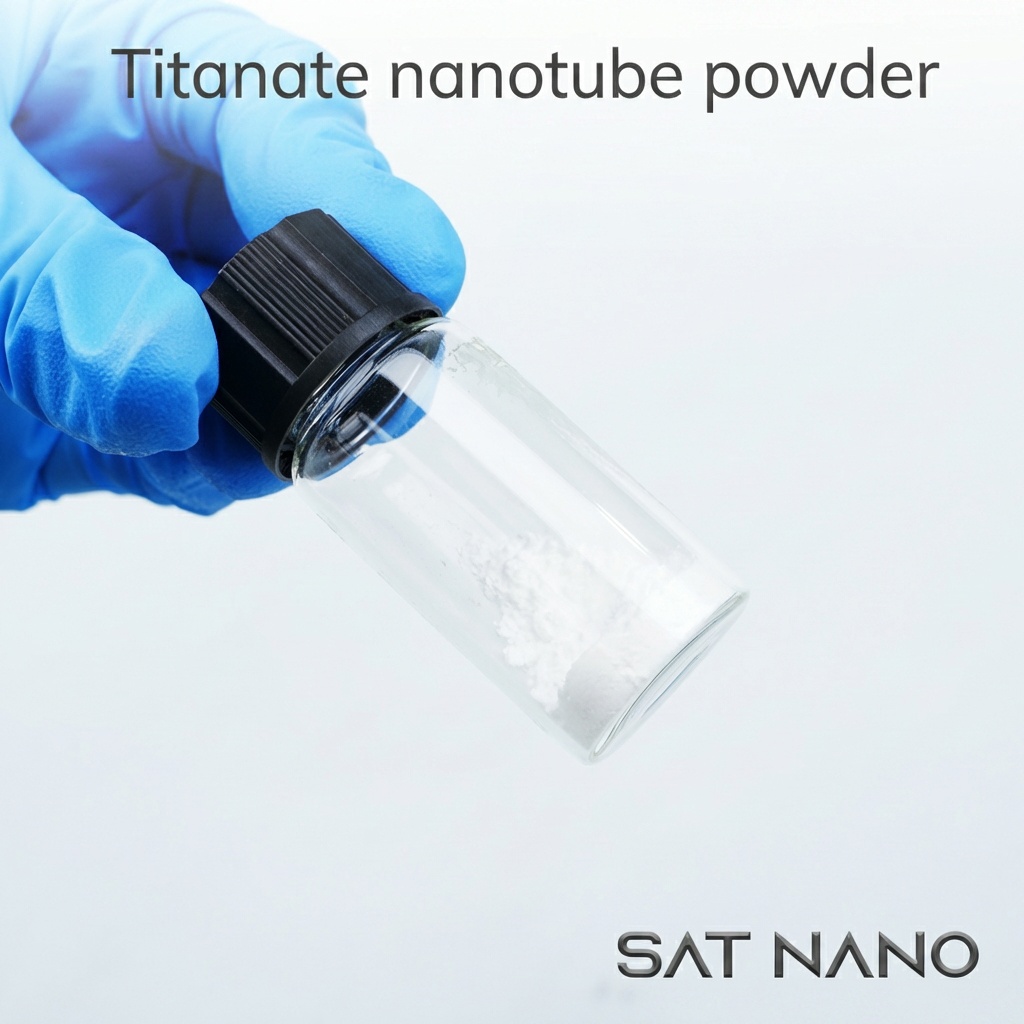
Surface Modification Strategies: What Has Been Tested?
To enhance the photocatalytic activity of Titanate Nanotubes Powder, researchers have applied three primary modification approaches. The table below summarises the key strategies evaluated at SAT NANO:
| Modification Type | Example Agents | Targeted Improvement | Bandgap Shift |
|---|---|---|---|
| Metal Doping | Cu, Fe, Pt nanoparticles | Trap electrons, extend light absorption | 3.2 → 2.4 eV |
| Non-metal Doping | N, C, S | Introduce mid-gap states for visible light | 3.2 → 2.7 eV |
| Surface Grafting | Amines, carboxylates | Enhance CO₂ adsorption affinity | No significant shift |
| Heterojunction | g-C₃N₄, rGO, CdS | Facilitate interfacial charge separation | 3.2 → 2.8 eV |
Among these, nitrogen-doped and Cu-decorated Titanate Nanotubes Powder demonstrated the most substantial gains in CO₂-to-CH₄ conversion yields under simulated solar irradiation.
Experimental Comparison: Modified vs. Pristine
SAT NANO conducted a side-by-side photoreduction test using a batch reactor (300 W Xe lamp, AM 1.5G filter). The reaction conditions were identical: 50 mg of Titanate Nanotubes Powder dispersed in 100 mL of CO₂‑saturated water containing 0.1 M NaHCO₃ as a sacrificial agent. The results are presented below:
| Parameter | Pristine TNTs | N‑doped TNTs | Cu‑decorated TNTs |
|---|---|---|---|
| CO₂ uptake (μmol/g) | 45 | 112 | 98 |
| CH₄ production (μmol/g·h) | 2.1 | 8.7 | 7.9 |
| CO production (μmol/g·h) | 1.8 | 3.2 | 4.5 |
| Apparent quantum efficiency (AQE, %) | 0.38 | 1.62 | 1.45 |
| Stability after 5 cycles (%) | 82 | 93 | 91 |
The data clearly indicate that surface‑modified Titanate Nanotubes Powder not only increases product yields but also exhibits superior stability—a critical factor for industrial deployment.
Why Does Surface Modification Work?
Three mechanistic benefits explain the enhanced efficiency:
-
Extended Light Harvesting – Doping creates intermediate energy levels within the bandgap, enabling Titanate Nanotubes Powder to utilise visible light (up to 550 nm), whereas pristine TNTs absorb only UV light (< 380 nm).
-
Accelerated Charge Separation – Surface-deposited metal nanoparticles (e.g., Cu) act as electron sinks, reducing the recombination rate by nearly 60%, as confirmed by transient photoluminescence spectroscopy.
-
Strengthened CO₂ Affinity – Amine grafting increases the surface basicity of Titanate Nanotubes Powder, raising CO₂ adsorption enthalpy from −12 kJ/mol to −38 kJ/mol, which directly correlates with higher local substrate concentration around active sites.
Frequently Asked Questions About Titanate Nanotubes Powder
Q1: What is the typical specific surface area of Titanate Nanotubes Powder, and how does it compare to commercial TiO₂ nanoparticles?
A: The specific surface area of hydrothermally synthesised Titanate Nanotubes Powder generally ranges from 250 to 400 m²/g, depending on the washing and calcination conditions. By contrast, commercial P25 TiO₂ nanoparticles offer only 50–60 m²/g. This 5‑ to 7‑fold increase in surface area provides exponentially more active sites for CO₂ adsorption and photocatalytic reactions. However, a higher surface area also means more surface defects, which can act as recombination centres—hence the need for careful surface modification to passivate non‑selective traps while preserving reactive facets.
Q2: Can Titanate Nanotubes Powder be regenerated after photoreduction cycles without significant activity loss?
A: Yes, and this is one of its strongest practical advantages. At SAT NANO, we have performed 10 consecutive regeneration cycles using a simple protocol: washing the used Titanate Nanotubes Powder with 0.1 M HCl to remove deposited carbonaceous intermediates, followed by drying at 80 °C and re‑calcination at 350 °C for 2 hours under nitrogen. After regeneration, the Cu‑decorated Titanate Nanotubes Powder retained 94 % of its initial CH₄ production rate, whereas pristine TNTs dropped to 76 %. The tubular morphology remained intact, as verified by TEM imaging, confirming that Titanate Nanotubes Powder possesses excellent structural robustness for long‑term catalytic applications.
Q3: Is surface‑modified Titanate Nanotubes Powder cost‑effective for large‑scale CO₂ conversion compared to other photocatalysts like g‑C₃N₄ or MOFs?
A: From a materials‑cost perspective, Titanate Nanotubes Powder is significantly more economical than MOFs, which require expensive organic linkers and metal clusters. The hydrothermal synthesis of TNTs uses inexpensive precursors (TiO₂ and NaOH) and operates at moderate temperatures (130–180 °C). Even after surface modification with dopants like nitrogen or copper, the overall raw material cost remains under $15 per gram, compared to $50–200 per gram for functionalised MOFs. When factoring in stability and recyclability, surface‑modified Titanate Nanotubes Powder offers a lower levelised cost per mole of CO₂ converted, making it a viable candidate for pilot‑scale solar fuel plants.
Practical Recommendations for Researchers
Based on our extensive testing, SAT NANO recommends the following protocol to maximise CO₂ photoreduction efficiency using Titanate Nanotubes Powder:
-
Choose N‑doping if your primary target is CH₄ selectivity (CO₂/CH₄ ratio drops from 0.86 to 0.37).
-
Choose Cu‑decoration if your goal is total CO + CH₄ yield (combined production reaches 12.4 μmol/g·h).
-
Always perform a pre‑adsorption step in the dark for 60 minutes to allow Titanate Nanotubes Powder to reach CO₂ equilibrium before turning on the light.
-
Maintain reaction pH between 6.5 and 7.5 – alkaline conditions suppress proton availability, while acidic conditions dissolve the nanotube structure.
Concluding Insight
Surface modification unequivocally elevates Titanate Nanotubes Powder from a modest UV‑active photocatalyst to a robust, visible‑light‑driven material with practical quantum efficiencies. The data from SAT NANO confirm that N‑doped and Cu‑decorated variants outperform pristine TNTs by 3‑ to 4‑fold in CH₄ production, with improved stability and regenerability. While pristine Titanate Nanotubes Powder retains value for baseline studies, any application targeting real‑world CO₂ mitigation under solar illumination will benefit substantially from tailored surface engineering.
Contact us today at SAT NANO to request customised Titanate Nanotubes Powder samples with your preferred dopant type and loading concentration. Our technical team provides full characterisation reports (BET, XRD, TEM, XPS) and supports pilot‑scale trials. Reach out via our website or email to discuss your specific photoreduction setup – we are ready to help you accelerate your sustainable catalysis research.