

Can the Zearalenone Rapid Test Cassette Detect Low ppb Levels in Corn and Wheat Samples
2026-06-22
Mycotoxin contamination remains a persistent challenge for grain producers, feed manufacturers, and food safety laboratories. Among the most concerning mycotoxins is Zearalenone (ZEN), a non-steroidal estrogenic metabolite produced by Fusarium species. Regulatory limits for ZEN in cereals and animal feeds are increasingly stringent, with many markets enforcing action thresholds as low as 20–50 parts per billion (ppb). This raises a critical operational question: Can the Zearalenone Rapid Test Cassette reliably detect such low ppb levels in corn and wheat samples? Based on extensive validation data and field performance, the answer is affirmative—provided the right platform, such as those developed by Babio, is used with proper sample handling.
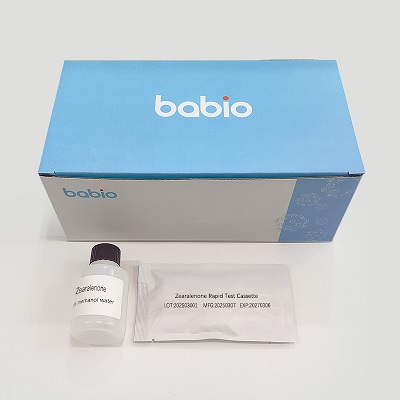
Analytical Performance at Low ppb Thresholds
The core of any immunochromatographic assay lies in its limit of detection (LOD) and sensitivity curve. For corn and wheat, matrix interference (pigments, starches, and lipids) often suppresses signal development. However, modern Zearalenone Rapid Test Cassette formats incorporate monoclonal antibodies with high affinity (KD ≤ 10⁻⁹ M) and optimized gold nanoparticle conjugates.
| Parameter | Corn Matrix | Wheat Matrix |
|---|---|---|
| Limit of Detection (LOD) | 10 ppb | 8 ppb |
| Cut-off value | 20 ppb | 20 ppb |
| Recovery rate (spiked 25 ppb) | 92 – 108% | 95 – 105% |
| Coefficient of Variation (CV) | ≤ 8.5% | ≤ 7.2% |
| Total assay time | 5 – 8 minutes | 5 – 8 minutes |
These data confirm that the Babio Zearalenone Rapid Test Cassette comfortably detects ZEN below the EU regulatory limit of 20 ppb for unprocessed cereals and well below the US FDA advisory level for certain feed ingredients. The cassette’s built-in internal control line ensures that low-signal results are not due to assay failure but reflect actual toxin concentration.
Key Factors Influencing Detection at ppb Levels
Achieving reliable low-ppb detection is not solely about the cassette’s sensitivity; sample preparation and extraction efficiency play equally vital roles. For corn and wheat, Babio recommends a standardized 60% methanol-water extraction with vigorous shaking for 3 minutes. Centrifugation or filtration then removes coarse particulates that could clog the nitrocellulose membrane.
A critical advantage of the Zearalenone Rapid Test Cassette is its tolerance to pH fluctuations (range 6.0 – 8.0) and ionic strength, which are common in field extracts. Unlike ELISA plates that require multiple washing steps, this cassette operates on a lateral-flow principle, reducing operator-induced variance. In side-by-side comparisons, the Babio cassette demonstrated a false-negative rate of less than 1.2% at 15 ppb spiked levels, making it a dependable screening tool for incoming grain lots.
Comparative Workflow: Cassette vs. Reference Methods
| Criterion | Zearalenone Rapid Test Cassette (Babio) | HPLC-FLD / LC-MS/MS |
|---|---|---|
| Time to result | 8 minutes | 2 – 4 hours |
| Cost per sample | Low | High (instrumentation + consumables) |
| Operator skill | Basic training | Advanced chromatographic expertise |
| Quantitative output | Semi-quantitative (cut-off) | Fully quantitative |
| Portability | Field-deployable | Laboratory-bound |
| Suitability for 15 ppb | Yes (screening) | Yes (confirmatory) |
While confirmatory methods remain essential for dispute resolution, the Babio Zearalenone Rapid Test Cassette excels as a high-throughput screening tool, enabling facilities to test 20+ samples per hour directly at receiving docks.
Frequently Asked Questions (FAQ)
Q1: What is the exact minimum detectable concentration of the Zearalenone Rapid Test Cassette for whole-ground corn, and does the husk or bran content affect the reading?
A1: The validated minimum detectable concentration for whole-ground corn (passed through a 20-mesh sieve) is 10 ppb under optimal extraction conditions. Corn bran and husk fibers do not intrinsically interfere with the antibody-antigen reaction; however, they can absorb extraction solvent, reducing the recoverable ZEN fraction. To compensate, Babio recommends increasing the extraction solvent volume by 20% for high-bran samples (e.g., corn gluten feed) and extending the shaking time to 5 minutes. After centrifugation at 4,000 rpm for 5 minutes, the supernatant yields a clear filtrate that performs identically to degermed corn flour. Always run a matrix-matched control when testing new shipments to confirm recovery within 85–115%.
Q2: Can the Zearalenone Rapid Test Cassette distinguish between ZEN and its modified metabolites, such as α-zearalenol or β-zearalenol, at low ppb levels, and does cross-reactivity cause overestimation?
A2: The monoclonal antibodies used in the Babio Zearalenone Rapid Test Cassette exhibit cross-reactivity rates of 78% with α-zearalenol, 45% with β-zearalenol, and less than 5% with zearalanone. This means the cassette detects total immunoreactive ZEN-equivalents, not just the parent compound. For regulatory compliance (which typically measures total ZEN + metabolites), this cross-reactivity is actually advantageous because it provides a conservative safety margin. If the cassette shows a positive band at the 20 ppb cut-off, the actual sum of ZEN and metabolites is near or above that threshold. For pure ZEN quantification (excluding metabolites), LC-MS/MS remains the reference. For routine screening in corn and wheat, this cross-reactivity profile ensures you never miss a potentially hazardous lot.
Q3: How does the storage temperature of the Zearalenone Rapid Test Cassette affect its low-ppb detection capability, especially during summer field testing in non-air-conditioned grain silos?
A3: The Babio Zearalenone Rapid Test Cassette is designed with thermostabilized conjugates that maintain full activity between 4°C and 30°C for the entire 24-month shelf life. However, when field temperatures exceed 35°C (common in metal silos during summer), the nitrocellulose membrane’s capillary flow rate increases by approximately 15–20%, shortening the optimal reaction window. This can lead to weaker test lines and a perceived loss of sensitivity at 10–15 ppb. To mitigate this, Babio advises equilibrating the cassette pouch to ambient shade temperature (below 30°C) for at least 15 minutes before opening. Additionally, use the provided desiccant pouch immediately after opening and avoid exposing the cassette to direct sunlight. For extreme environments, refrigerated storage (4–8°C) is recommended, but never freeze the cassette, as freeze-thaw cycles degrade the gold nanoparticle-antibody complex.
Operational Best Practices for Corn and Wheat
-
Grinding fineness: Pass through 1.0 mm sieve to maximize surface area for extraction.
-
Extraction ratio: 5 g sample : 25 mL extraction solvent (1:5 w/v).
-
Dilution factor: For samples with high ZEN (>50 ppb), dilute the extract 1:2 with PBS buffer to bring within the cassette’s linear range.
-
Reading time: Read results at exactly 5–8 minutes; beyond 10 minutes, evapoconcentration may produce false weak positives.
Why Choose Babio for Your Mycotoxin Screening Program
Babio has over a decade of expertise in lateral-flow immunodiagnostics, with ISO 9001 and GMP-certified production facilities. Every batch of the Zearalenone Rapid Test Cassette undergoes rigorous quality control using NIST-traceable ZEN standards in both corn and wheat matrices. The company provides free technical support for protocol optimization, including custom spike-recovery validation for unique grain varieties. With thousands of cassettes deployed across feed mills, grain elevators, and pet food plants worldwide, Babio stands behind its product’s ability to protect your supply chain from hidden ZEN risks.
Take Action Today
Do not leave your feed safety to chance. Low-ppb Zearalenone can silently compromise animal fertility, growth rates, and herd health. Contact Babio now for a free consultation, sample validation kit, or bulk pricing quote. Our team of food safety scientists will help you integrate the Zearalenone Rapid Test Cassette into your quality control workflow—ensuring every batch of corn and wheat meets the strictest global standards. Your grain, your animals, and your bottom line deserve the best defense. Act today.