
Does the Fumonisin Rapid Test Cassette Require Any Special Sample Preparation Equipment
2026-08-13
For quality control managers and grain processors, the question of equipment needs often determines whether a testing method is practical for routine use. The short answer is no—the Fumonisin Rapid Test Cassette from Babio is deliberately designed to minimize reliance on costly, specialized lab instruments. However, "minimal" does not mean "none." Understanding exactly what you need—and what you can skip—is essential for maintaining accuracy without over-investing in infrastructure.
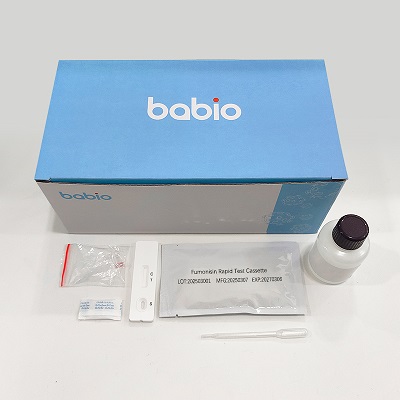
What the Fumonisin Rapid Test Cassette Actually Requires
The Babio Fumonisin Rapid Test Cassette operates on a competitive immunochromatographic principle. Unlike HPLC or LC-MS/MS, it does not require nitrogen evaporators, centrifugal vacuum concentrators, or solid-phase extraction manifolds. The core sample preparation workflow involves three simple stages: extraction, dilution, and filtration.
Below is a clear breakdown of what is mandatory versus what is optional:
| Equipment Item | Mandatory? | Purpose | Typical Alternative |
|---|---|---|---|
| Analytical balance (0.1 g accuracy) | Yes | Weighing ground sample accurately | Pre-weighed sample sachets (if supplied) |
| Laboratory mill or grinder | Yes | Grinding grain to pass through 20-mesh sieve | Commercial blender with fine-grid capability |
| Graduated cylinder or volumetric flask | Yes | Measuring extraction solvent (e.g., 50 mL) | Pre-measured solvent bottles from Babio kits |
| Shaker or vortex mixer | Yes | Extracting fumonisin from solid matrix | Wrist-action shaker or magnetic stirrer |
| Filter paper or syringe filter (0.45 µm) | Yes | Removing particulate matter before testing | Centrifuge at 3,000 rpm for 5 minutes |
| Micropipette (100–200 µL) | Yes | Transferring clear extract to the cassette | Disposable transfer pipettes (included in some kits) |
| Timer | Yes | Ensuring exact 10-minute incubation | Smartphone stopwatch |
| Centrifuge | Optional | Faster clarification instead of filtering | Syringe filter works perfectly |
| pH meter | Optional | Checking extract pH (only if water source is suspect) | pH test strips |
| Heating block | No | Not required for this lateral-flow assay | Room-temperature operation (15–30°C) |
Step-by-Step Equipment Setup for Babio Users
With the Babio Fumonisin Rapid Test Cassette, a typical sample preparation station occupies less than 2 square feet of bench space. The entire process—from ground sample to result—takes about 22 minutes, of which only 8 minutes involve active hands-on work.
-
Grind 50 g of representative grain sample to fine powder (pass 20-mesh).
-
Weigh 5.0 g of ground sample into a clean extraction jar.
-
Add 25 mL of 70% methanol/water extraction solution (provided or prepared).
-
Shake vigorously for 3 minutes on a platform shaker.
-
Filter through Whatman No. 1 paper or a 0.45 µm syringe filter.
-
Dilute the filtrate with provided buffer (usually 1:5 or 1:10 ratio—refer to kit insert).
-
Apply 100 µL of diluted extract onto the sample well of the cassette.
-
Wait 10 minutes and read the result visually or with a strip reader.
No nitrogen tank, no rotary evaporator, and no HPLC autosampler—just basic lab essentials that any feed mill or grain elevator already owns.
Why Babio Keeps It Simple
The engineering philosophy behind Babio is to democratize mycotoxin testing. Every Fumonisin Rapid Test Cassette is pre-coated with monoclonal antibodies and colloidal gold conjugates, so the biochemistry is stable and ready to use. The extraction chemistry has been optimized to work with standard 70% methanol, a solvent already stocked in most quality labs. This design choice directly reduces the barrier to entry for small-to-medium enterprises that cannot afford dedicated mycotoxin analysts.
Fumonisin Rapid Test Cassette FAQ – Common Questions
Q1: Can I use tap water instead of distilled water for preparing the extraction solvent?
A1: No—tap water contains variable levels of minerals, chlorine, and organic matter that can alter the ionic strength and pH of the extraction buffer. This interference may cause non-specific binding on the nitrocellulose membrane, leading to faint test lines or false negatives. Babio strongly recommends using deionized or distilled water (conductivity < 5 µS/cm) for all reconstitution and dilution steps. If distilled water is unavailable, commercially bottled purified water for laboratory use is an acceptable substitute, provided you run a positive control first.
Q2: Does the Fumonisin Rapid Test Cassette require a different extraction procedure for maize versus wheat versus sorghum?
A2: Yes—the extraction time and solvent-to-sample ratio vary by matrix due to differences in starch, protein, and fiber content. For maize (corn), the standard protocol uses 25 mL of 70% methanol per 5 g sample with 3 minutes of shaking. For wheat, which has higher gluten content, Babio recommends extending the shaking time to 5 minutes and using a 1:8 dilution after filtration to reduce viscosity. For sorghum, which contains tannins that can bind fumonisins, a double-filtration step (filtering twice through the same 0.45 µm filter) is advised to eliminate interfering polyphenols. Always consult the specific matrix table in the Babio product insert—deviating from these parameters without validation will compromise accuracy.
Q3: What is the minimum sample size I can test if I have limited grain quantity?
A3: The validated protocol requires a 5.0 g test portion to ensure statistical representativeness, as fumonisins are notoriously heterogeneously distributed in contaminated lots (the "hot spot" phenomenon). However, Babio has internally validated a miniaturized procedure using 2.0 g of sample with 10 mL of extraction solvent, maintaining the same 1:5 ratio. This mini-procedure is acceptable for screening purposes only—not for regulatory decision-making. For official dispute resolution or export certification, you must adhere to the full 5.0 g protocol. If you have less than 2 g of material, the Fumonisin Rapid Test Cassette is not recommended, as sampling error becomes unacceptably high (>30% CV).
Performance Comparison at a Glance
To put equipment requirements into perspective, here is how Babio compares with other methods:
| Parameter | Babio Rapid Test Cassette | ELISA | HPLC-FLD |
|---|---|---|---|
| Sample prep equipment cost | < $800 | $2,000–$5,000 | > $25,000 |
| Hands-on time per sample | 8 min | 25 min | 60 min |
| Solvent waste per test | ~25 mL | ~100 mL | ~500 mL |
| Specialized training needed | Basic | Moderate | Advanced |
| Portability (field use) | Yes | Limited | No |
Final Verdict
The Fumonisin Rapid Test Cassette from Babio does not demand expensive, hard-to-find equipment. A standard mill, a balance, a shaker, and basic filtration tools are sufficient to generate reliable, repeatable results. The cassette is purpose-built for production-floor environments where speed and simplicity matter more than analytical complexity.
Contact Us
Have more questions about sample preparation, matrix-specific protocols, or bulk ordering? The Babio technical support team is ready to assist with customized validation plans and on-site training. Reach out to us through our website contact form or email us directly—we respond to all inquiries within 4 business hours. Let us help you integrate the Fumonisin Rapid Test Cassette into your quality workflow with confidence and zero guesswork.