

How Do Tallow Amines Ethoxylates Compare to Other Ethoxylated Amines in Performance
2026-09-18
Tallow Amines Ethoxylates are a specialized class of nonionic surfactants derived from natural tallow fatty amines, and Polykem has been manufacturing them for industrial formulators who demand consistent emulsification, wetting, and antistatic performance. Understanding how they stack up against other ethoxylated amines — such as coco amine ethoxylates, oleyl amine ethoxylates, and stearyl amine ethoxylates — helps formulators select the right chemistry for demanding applications.
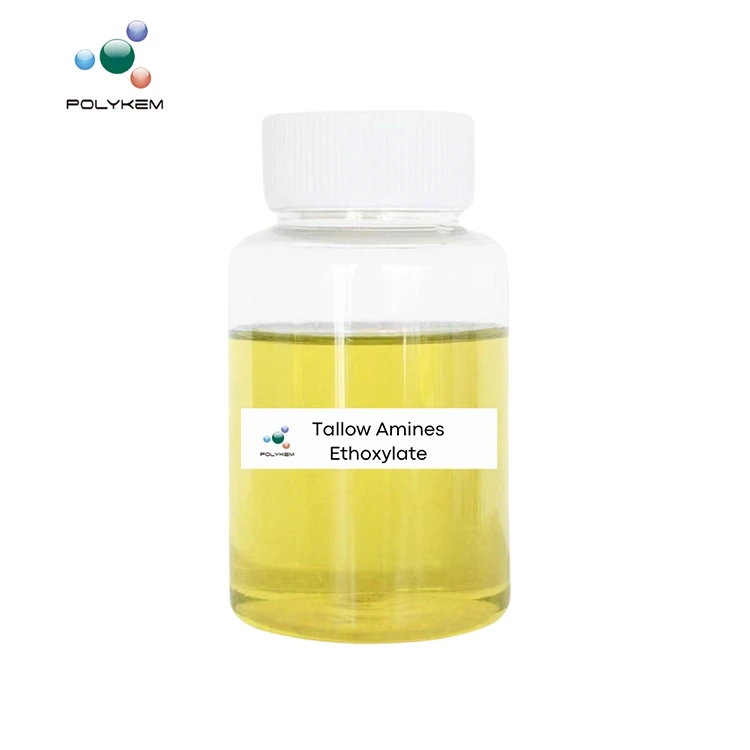
Key Performance Comparison
| Property | Tallow Amines Ethoxylates | Coco Amine Ethoxylates | Oleyl Amine Ethoxylates | Stearyl Amine Ethoxylates |
|---|---|---|---|---|
| Hydrophobe chain | C16–C18 (mixed) | C12–C14 | C18 unsaturated | C18 saturated |
| Cloud point | Moderate | Lower | Moderate | Higher |
| Emulsification | Excellent, balanced | Good, oil-loving | Good, fluid | Strong, waxy |
| Wetting speed | Fast | Very fast | Moderate | Slow |
| Antistatic performance | Strong | Moderate | Good | Very strong |
| Biodegradability | Good | Good | Moderate | Moderate |
| Cost efficiency | High | High | Moderate | Moderate |
Why the C16–C18 Blend Matters
The mixed C16–C18 chain length in Tallow Amines Ethoxylates delivers a balance that single-chain ethoxylated amines struggle to match:
-
Emulsification: The blend stabilizes both oil-in-water and water-in-oil systems, making it versatile across agrochemical, textile, and metalworking formulations.
-
Wetting and dispersing: Faster wetting than stearyl-based amines while retaining better thermal stability than coco-based grades.
-
Antistatic and corrosion inhibition: The longer chain provides durable film formation on metal and fiber surfaces.
-
Formulation flexibility: Adjustable ethylene oxide (EO) content allows tuning from oil-soluble to water-soluble behavior.
Polykem's Advantage
Polykem produces Tallow Amines Ethoxylates with tightly controlled EO distribution, low free amine content, and batch-to-batch consistency. This reduces reformulation risk and supports compliance with evolving regulatory standards.
Frequently Asked Questions
Q: What makes Tallow Amines Ethoxylates different from coco amine ethoxylates?
A: Tallow Amines Ethoxylates are built on C16–C18 fatty chains, giving higher thermal stability, stronger antistatic effects, and better emulsification in high-temperature systems, while coco amine ethoxylates (C12–C14) offer faster wetting but lower heat resistance.
Q: Are Tallow Amines Ethoxylates suitable for biodegradable formulations?
A: Yes, Tallow Amines Ethoxylates with moderate EO content generally biodegrade well under aerobic conditions, though degradation speed depends on EO number, concentration, and wastewater treatment conditions.
Q: How does EO number affect the performance of Tallow Amines Ethoxylates?
A: Lower EO numbers (2–5) favor oil solubility, emulsification, and corrosion inhibition, while higher EO numbers (10–20) improve water solubility, wetting, and antistatic performance. Polykem supplies multiple EO grades to match specific application needs.
Conclusion
Choosing between Tallow Amines Ethoxylates and other ethoxylated amines comes down to the balance of thermal stability, emulsification, wetting, and cost. For formulators needing a versatile, high-performance nonionic surfactant, Tallow Amines Ethoxylates from Polykem offer a reliable, scalable solution backed by technical support and consistent quality.
Contact us today to request samples, technical data sheets, or a custom Tallow Amines Ethoxylates formulation consultation with the Polykem team.