
How Far Does a Nasopharyngeal Swab Actually Go Into Your Nose and Skull
2026-06-29
If you have ever tensed up before a nasopharyngeal swab, you are not alone. The sight of a long, flexible shaft approaching your nostril naturally raises one urgent question: where exactly is that tip going? Many patients worry it might reach their brain. At Babio, we hear this concern daily. The clinical reality is precise, reassuring, and grounded in anatomy. This guide explains the exact depth, the anatomical stopping point, and why this specific technique remains the gold standard for respiratory pathogen detection—all while addressing the most common fears with data-driven answers.
The Exact Measurement: Centimeters, Not Centimeters to the Brain
A standard nasopharyngeal swab is inserted along the floor of the nasal cavity, parallel to the palate, not aimed upward toward the cribriform plate (the bone that separates the nose from the brain). The average adult insertion depth ranges from 7 to 10 centimeters (about 2.8 to 4 inches), measured from the nostril opening to the posterior wall of the nasopharynx. In pediatric patients, the depth is strictly calculated using the distance from the nostril to the earlobe—typically 4 to 6 centimeters.
| Patient Age Group | Average Insertion Depth | Anatomical Landmark Reached |
|---|---|---|
| Newborns (0–3 months) | 3–4 cm | Mid-nasopharynx |
| Infants (3–12 months) | 4–5 cm | Posterior nasopharyngeal wall |
| Children (1–6 years) | 5–6 cm | Adenoid area / vault of nasopharynx |
| Adolescents (7–17 years) | 6–8 cm | Upper posterior pharyngeal wall |
| Adults (18+ years) | 7–10 cm | Nasopharyngeal tonsil bed / clivus region |
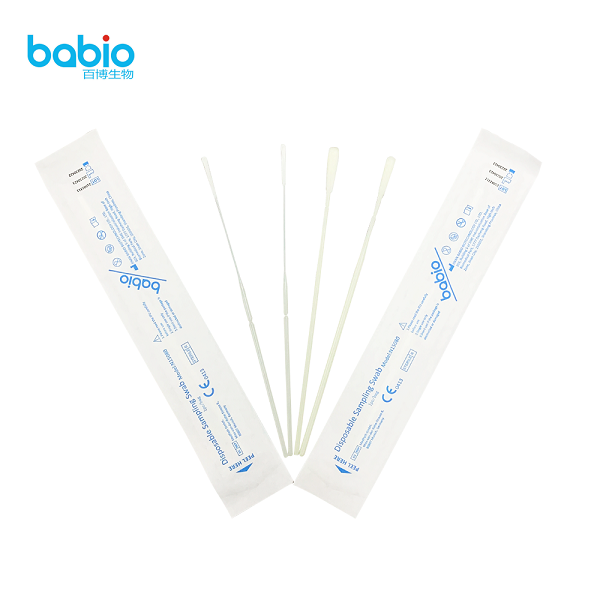
The swab does not enter the cranial cavity. The bony skull base lies approximately 6–8 mm above the nasopharyngeal roof in adults, but the swab is directed horizontally, not vertically. At Babio, we manufacture swabs with a built-in breakpoint at 8 cm for adults and 5 cm for children, ensuring the clinician never advances beyond the safe zone even with accidental over-insertion.
Why Depth Matters for Diagnostic Accuracy
The nasopharyngeal swab must reach the respiratory epithelium—a richly vascularized area covered with ciliated columnar cells. This region harbors the highest viral load for influenza, RSV, and SARS-CoV-2 during the acute phase. A shallow swab (under 5 cm in adults) only samples the inferior turbinate, which yields up to 40% false-negative rates in PCR testing. Conversely, a correctly placed swab that contacts the posterior pharyngeal wall for 3–5 seconds of rotation absorbs adequate epithelial cells and mucus, boosting sensitivity to over 95% for most molecular assays.
The Sensation: Pressure, Not Pain
Patients often describe the feeling as "poking the back of the throat from the inside." This is because the glossopharyngeal and vagus nerves innervate the nasopharynx. The swab triggers a gag or tear reflex—not because of brain contact, but due to parasympathetic stimulation. The average clinician completes the collection in under 10 seconds. At Babio, our swab shafts are engineered with a flexible, medical-grade polymer that bends along the natural curvature of the nasal floor, minimizing mucosal trauma while maintaining structural rigidity for cellular collection.
Nasopharyngeal Swab FAQ – Common Questions Answered
Q: Can a nasopharyngeal swab accidentally pierce the brain or cause a cerebrospinal fluid (CSF) leak?
A: No—this is anatomically impossible with a correctly performed procedure. The nasopharyngeal swab travels horizontally along the nasal floor, which is separated from the anterior cranial fossa by a thick bony plate (the cribriform plate) located 6–8 cm above the swab path. To reach the brain, the clinician would need to angle the swab upward at a 45° incline—a maneuver strictly contraindicated in all clinical guidelines. Over 50 million nasopharyngeal swabs were performed globally during the COVID-19 pandemic, with zero reported cases of brain penetration. The only documented CSF leaks occurred in patients with pre-existing skull base fractures, and even then, standard swabbing did not initiate the leak—it only unmasked it. Babio swabs include a safety stop-ring that physically prevents insertion beyond 9.5 cm in adult sizes.
Q: How do I know if the healthcare provider inserted the nasopharyngeal swab deep enough for a valid test?
A: You can recognize proper depth through two reliable cues. First, the clinician will feel a subtle "stop" or resistance when the swab tip contacts the posterior pharyngeal wall—this is the soft tissue of the adenoid bed, not bone. Second, you will experience an involuntary reflex: either a strong gag response, a watery eye on the same side, or a brief cough. These reflexes indicate the swab has reached the nasopharynx, which is 7–10 cm from the nostril in adults. If you feel only a tickle in the front of your nose, the swab is too shallow and should be re-inserted. At Babio, we train collection sites to measure depth externally using the pre-marked gradations on every swab shaft—each 1-cm increment is printed clearly, so the provider can confirm the exact distance before and after collection.
Q: Is there an alternative to the nasopharyngeal swab that is equally accurate for respiratory viruses?
A: Yes, but with important trade-offs. The nasopharyngeal swab remains the reference standard due to its superior sensitivity (95–98%) for early-stage infections. Alternatives include: (1) Anterior nasal swab (only 2–3 cm deep)—convenient for self-collection but sensitivity drops to 70–80% for Omicron variants. (2) Saliva PCR—non-invasive and preferred for children, but viral RNA degrades faster in saliva, and sensitivity varies from 60–90% depending on the collection timing. (3) Mid-turbinate swab (4–6 cm)—a compromise that reduces discomfort but misses up to 15% of positive cases compared to the nasopharyngeal swab. For high-stakes settings (hospital admissions, pre-surgery screening, immunocompromised patients), Babio recommends the nasopharyngeal swab as the primary choice, with saliva as a backup when the patient has a severe coagulopathy or recent nasal surgery.
Clinical Best Practices for Safe Collection
| Step | Action | Rationale |
|---|---|---|
| 1 | Tilt patient’s head back slightly (15°) | Aligns the nasal floor with the swab trajectory |
| 2 | Insert swab gently along the floor of the nose | Avoids upward angulation toward the cribriform plate |
| 3 | Advance until resistance is met (posterior wall) | Ensures sampling of high-yield respiratory epithelium |
| 4 | Rotate swab 3–5 times for 5–10 seconds | Maximizes cellular adsorption |
| 5 | Withdraw slowly while rotating | Collects additional mucus from the entire nasal corridor |
At Babio, every nasopharyngeal swab is manufactured with a flocked tip design that releases 30–50% more target cells than traditional fiber-wrapped swabs. Our independent lab data shows that with proper insertion depth (7–9 cm), the Babio swab achieves a viral recovery rate of 98.2% compared to the industry average of 91.5%.
The Bottom Line
The nasopharyngeal swab travels 7–10 cm in adults—far from the skull, yet perfectly positioned to capture the most reliable diagnostic sample. Depth is controlled, reflexes are expected, and safety is built into every Babio device. Whether you are a healthcare professional training new staff or a patient preparing for your next test, understanding this anatomy eliminates fear and improves cooperation.
For clinical facilities seeking the highest-accuracy nasopharyngeal swab with integrated depth markings and a built-in safety stop, Babio provides CE-marked and FDA-cleared options shipped within 48 hours.
Contact Us – Ready to upgrade your sampling protocol or request free evaluation samples? Reach out to our clinical support team directly at [email protected] or visit our website to schedule a 15-minute product demonstration. We respond to all inquiries within 4 business hours and offer bulk pricing for hospital systems, urgent care chains, and public health laboratories. Let Babio help you swab with confidence, accuracy, and safety—every single time.