

How Is Antimony Trioxide Used Across Flame Retardant and Industrial Applications?
2025-12-30
Abstract
Antimony Trioxide (Sb2O3) is a widely used inorganic compound recognized for its role as a synergist in flame retardant systems and as a functional additive in plastics, rubber, coatings, glass, and electronics. This article provides a structured and in-depth explanation of how Antimony Trioxide is produced, specified, and applied in modern industries. It also addresses key technical parameters, regulatory considerations, and common questions relevant to procurement, formulation, and long-term market development.
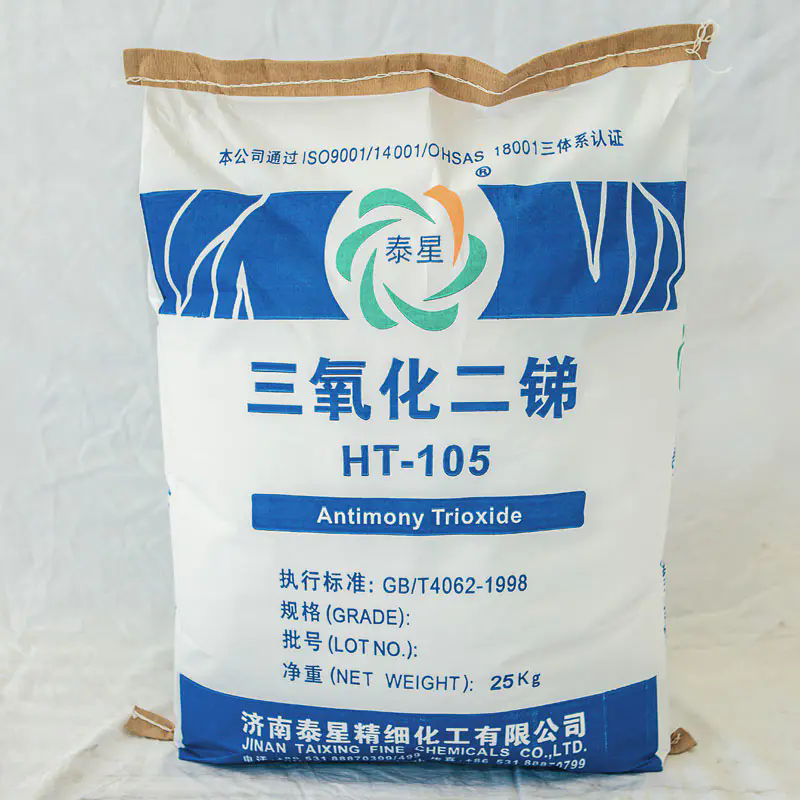
Table of Contents
- How Is Antimony Trioxide Defined and Positioned in Industry?
- How Do Technical Parameters Determine Antimony Trioxide Performance?
- How Does Antimony Trioxide Function in Key Industrial Applications?
- How Do Common Questions About Antimony Trioxide Get Answered?
- How Is the Antimony Trioxide Market Expected to Evolve?
- How Does Shandong Taixing Support Global Antimony Trioxide Demand?
How Is Antimony Trioxide Defined and Positioned in Industry?
Antimony Trioxide is an inorganic oxide derived primarily from antimony-bearing ores through controlled oxidation or volatilization processes. In commercial markets, it is typically supplied as a fine white powder with high purity and controlled particle size distribution. Its primary industrial value lies in its ability to enhance flame retardant efficiency when combined with halogenated compounds, forming a stable antimony halide layer that suppresses combustion reactions.
Beyond flame retardancy, Antimony Trioxide also serves functional roles in pigments, opacifiers, catalysts, and clarifying agents. These diversified applications make it a strategically important material across polymer processing, electronics manufacturing, construction materials, and specialty chemicals.
How Do Technical Parameters Determine Antimony Trioxide Performance?
Product performance in downstream applications is directly influenced by a set of measurable technical parameters. Consistency in these specifications is essential for industrial users seeking predictable processing behavior and regulatory compliance.
| Parameter | Typical Specification Range | Industrial Relevance |
|---|---|---|
| Chemical Formula | Sb2O3 | Defines chemical identity and reaction behavior |
| Antimony Content | ≥ 99.5% | Indicates purity and flame retardant efficiency |
| Particle Size (D50) | 0.8–1.5 μm | Affects dispersion in polymers and coatings |
| Whiteness | ≥ 96% | Important for visual-sensitive applications |
| Bulk Density | 0.7–1.0 g/cm³ | Influences handling and dosing accuracy |
| Loss on Ignition | ≤ 0.4% | Reflects thermal stability |
Controlled particle morphology and low impurity levels ensure Antimony Trioxide integrates efficiently into polymer matrices without compromising mechanical or aesthetic properties.
How Does Antimony Trioxide Function in Key Industrial Applications?
In flame retardant systems, Antimony Trioxide acts as a synergist rather than a standalone flame retardant. When exposed to heat, it reacts with halogenated flame retardants to form antimony halides, which interfere with free-radical combustion reactions in the gas phase.
In plastics and rubber, this mechanism enables manufacturers to achieve targeted fire safety standards while optimizing additive loading levels. In coatings and paints, Antimony Trioxide contributes to opacity, weather resistance, and fire performance. The glass and ceramics industries utilize it for fining and clarification, improving optical quality by removing bubbles and impurities during melting processes.
Electronics and electrical components benefit from its role in insulating materials, where flame resistance and long-term thermal stability are critical performance requirements.
How Do Common Questions About Antimony Trioxide Get Answered?
Q: How does Antimony Trioxide improve flame retardant efficiency?
A: It reacts synergistically with halogenated compounds to form antimony halides, which inhibit flame propagation by disrupting free-radical reactions during combustion.
Q: How is particle size important when selecting Antimony Trioxide?
A: Smaller and more uniform particle sizes enhance dispersion in polymers, reduce agglomeration, and provide more consistent flame retardant performance.
Q: How is Antimony Trioxide handled to ensure safety and compliance?
A: Industrial handling requires dust control, proper ventilation, and adherence to local occupational safety regulations to minimize inhalation exposure.
Q: How does Antimony Trioxide differ from alternative synergists?
A: It offers a balanced combination of cost efficiency, thermal stability, and compatibility with established flame retardant formulations.
How Is the Antimony Trioxide Market Expected to Evolve?
Market demand for Antimony Trioxide is influenced by regulatory fire safety standards, infrastructure development, and the expansion of electronics and automotive sectors. While environmental considerations are shaping material selection, Antimony Trioxide continues to maintain relevance due to its proven performance and adaptability in evolving formulations.
Ongoing research focuses on optimizing particle engineering and improving compatibility with low-halogen or halogen-free systems, supporting long-term application stability.
How Does Shandong Taixing Support Global Antimony Trioxide Demand?
Shandong Taixing supplies Antimony Trioxide engineered to meet international industrial standards, emphasizing consistency in purity, particle control, and batch-to-batch reliability. Through stable production capacity and technical support, Shandong Taixing serves manufacturers across flame retardant, plastics, coatings, and specialty material markets.
For detailed specifications, customized requirements, or application guidance, contact Shandong Taixing to discuss how Antimony Trioxide solutions can align with specific production and compliance objectives.