

What is the impact of diagenetic processes on fine reservoir description in clastic reservoirs
2026-04-02
Diagenetic processes fundamentally alter the porosity, permeability, and pore structure of clastic reservoirs, directly influencing the accuracy of fine reservoir description. At Nuoer Energy, we recognize that ignoring diagenetic overprints leads to overestimated reservoir quality and failed production forecasts. This article examines how compaction, cementation, and dissolution shape reservoir characterization and provides actionable insights for geoscientists and engineers.
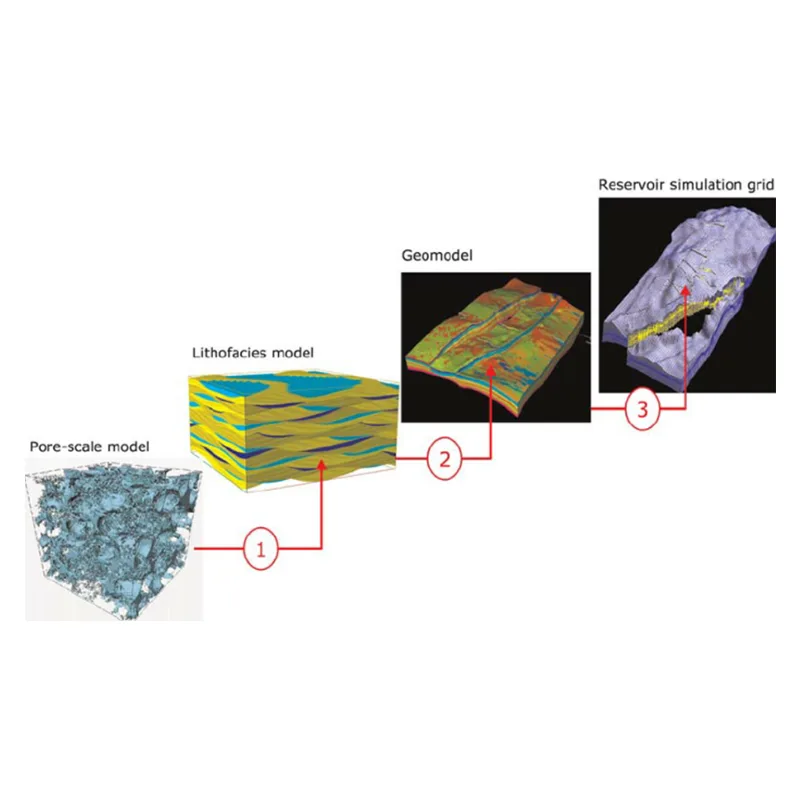
The Core Impact of Diagenesis on Fine Reservoir Description
Diagenetic events modify depositional fabrics post-burial. In fine reservoir description, these modifications determine net pay zones, flow units, and heterogeneity patterns. The table below summarizes key diagenetic processes and their impacts.
| Diagenetic Process | Primary Effect on Reservoir | Consequence for Fine Reservoir Description |
|---|---|---|
| Mechanical Compaction | Reduces porosity by grain rearrangement | Underestimates original intergranular volume; requires compaction correction in models |
| Quartz Cementation | Occludes primary pores | Creates false low-permeability barriers; alters flow unit connectivity |
| Clay Authigenesis (e.g., illite, kaolinite) | Reduces pore throat radius | Microporosity misidentified as effective porosity; impacts capillary pressure curves |
| Dissolution (feldspar, carbonate cements) | Creates secondary porosity | Enhances local permeability but adds heterogeneity; needs separate porosity class |
| Pressure Dissolution (stylolites) | Generates impermeable seams | Acts as internal baffles; critical for reservoir segmentation in 3D models |
How Diagenesis Changes Workflow Priorities
Traditional fine reservoir description relying solely on depositional facies fails in diagenetically altered rocks. Three major workflow adjustments are required:
-
Diagenetic Facies Mapping – Group rocks by similar diagenetic overprint, not just grain size.
-
Porosity Type Partitioning – Separate primary vs. secondary porosity in log interpretation.
-
Permeability Prediction – Use pore-throat attributes (e.g., NMR T2 cutoffs) instead of standard porosity-permeability transforms.
Nuoer Energy integrates diagenetic forward modeling with petrophysical data to reduce uncertainty in clastic reservoir models.
Fine Reservoir Description FAQ
What is the most damaging diagenetic process for fine reservoir description in clastic reservoirs?
Quartz cementation and authigenic clays (especially fibrous illite) are most damaging. Quartz cement reduces primary porosity systematically but predictably, while illite bridges pore throats, causing extreme permeability reduction without proportional porosity loss. In fine reservoir description, illite-rich zones often appear as good porosity from logs but deliver near-zero permeability. This mismatch leads to erroneous flow unit classification. Correct identification requires SEM-based pore fabric analysis and special core analysis (SCAL) with clay-sensitive petrophysical models.
How can fine reservoir description account for diagenetic heterogeneity at sub-seismic scale
Diagenetic heterogeneity operates at lamina to bed scale, invisible to seismic. To capture it, fine reservoir description must combine high-resolution micro-CT scanning of core plugs with multi-scale data integration: thin-section petrography (mm-cm), routine core analysis (cm-dm), and borehole image logs (dm-m). Machine learning clustering of wireline log responses (e.g., density-neutron crossplot, spectral gamma ray) can map diagenetic facies away from cored wells. Nuoer Energy uses a hierarchical classification scheme where depositional facies are first identified, then overprinted by diagenetic modifiers.
Does dissolution always improve reservoir quality in fine reservoir description
No. While feldspar dissolution creates secondary macropores and enhances permeability, it also generates unstable fabrics. Excessive dissolution leads to loose framework grains, fines migration during production, and potential formation damage. Moreover, dissolution is highly localized. In fine reservoir description, zones with intense dissolution often appear as sweet spots, but adjacent tight zones may act as flow baffles due to secondary precipitated phases (e.g., kaolinite from feldspar alteration). Therefore, dissolution must be modeled as a connectivity-controlled diagenetic facies, not a uniform enhancement.
Practical Recommendations for Clastic Reservoirs
| Reservoir Type | Diagenetic Risk | Recommended Fine Reservoir Description Approach |
|---|---|---|
| Shallow marine (clean sands) | Quartz overgrowths | Use porosity-depth trends with thermal history |
| Deep-water turbidites | Authigenic clays | Apply multi-mineral log analysis with clay typing |
| Fluvial (arkosic sands) | Dissolution & kaolinite | Integrate 3D porosity partitioning by diagenetic phase |
Nuoer Energy delivers diagenetically informed fine reservoir description that reduces static model uncertainty and improves dynamic prediction.
Contact Us
Understanding diagenesis is not optional—it is the difference between a profitable development and a costly miscalculation. If your clastic reservoir models are failing to match production, Nuoer Energy can help. Our team specializes in diagenetic facies analysis, high-resolution reservoir characterization, and integrated petrophysical solutions. Contact us today to discuss your project needs and bring geological realism back to your reservoir models.