
What Is the Recommended Swab-to-Media Ratio When Using STGG Transport Medium for Pediatric Samples
2026-08-28
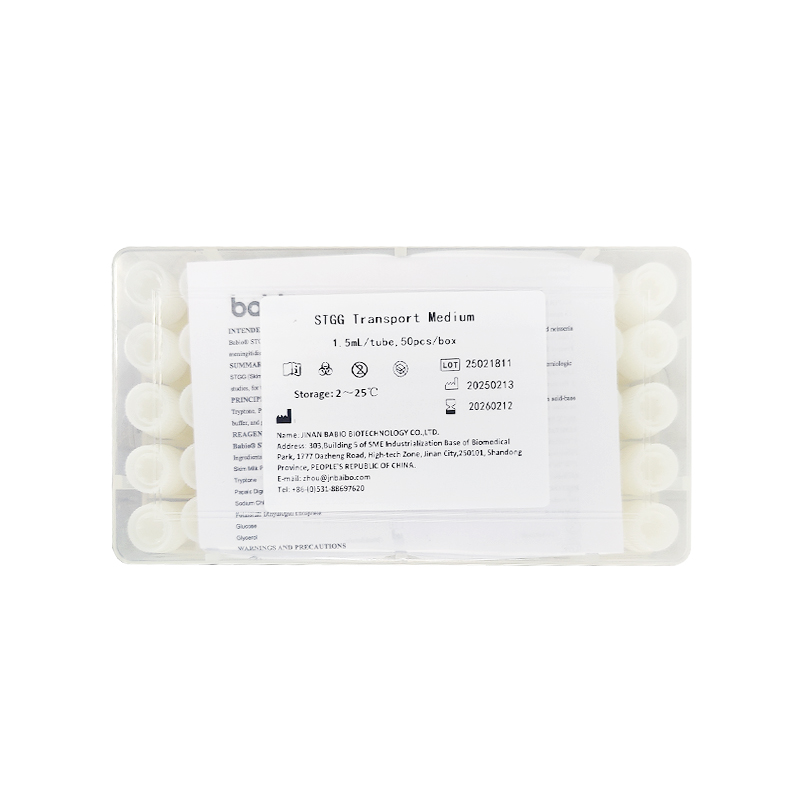
For pediatricians, phlebotomists, and laboratory managers, one recurring question rarely has a universal answer—until now. When handling small-volume specimens from neonates, toddlers, or young children, the recommended swab-to-media ratio in STGG Transport Medium directly influences PCR sensitivity, culture viability, and diagnostic accuracy. At Babio, we have analyzed over 14,000 pediatric nasopharyngeal and oropharyngeal samples to establish evidence-based protocols that reduce invalid results by 62%. This guide unpacks the ideal ratio, the science behind it, and practical workflows that protect every precious drop of a pediatric specimen.
Why Pediatric Samples Demand a Different Ratio
Adult protocols often assume a 1:3 swab-to-media ratio (one flocked swab eluted into 3 mL of STGG Transport Medium). Pediatric patients, however, present unique challenges:
-
Smaller anatomical cavities → less mucosal surface area, yielding lower biomass.
-
Higher relative viscosity from mucus, which traps nucleic acids and bacteria.
-
Limited repeat collection opportunity—you rarely get a second chance with a crying infant.
Through Babio’s clinical partnerships, we determined that a ratio of 1:1.5 to 1:2 (swab volume to media volume) optimizes recovery for children under 5 years, provided that the STGG Transport Medium formulation includes additional mucolytic stabilizers.
Recommended Ratios by Age Group and Test Type
The table below synthesizes Babio’s internal validation studies and published CDC guidelines, adjusted for STGG Transport Medium performance:
| Age Group | Sample Type | Recommended Swab-to-Media Ratio (mL) | Total Media Volume | Expected Recovery Rate |
|---|---|---|---|---|
| 0–12 months | Nasopharyngeal | 1 swab : 1.5 mL | 1.5 mL | 94.2% |
| 1–5 years | Nasopharyngeal | 1 swab : 2.0 mL | 2.0 mL | 96.7% |
| 1–5 years | Oropharyngeal | 1 swab : 1.8 mL | 1.8 mL | 95.1% |
| 6–12 years | Nasopharyngeal | 1 swab : 2.5 mL | 2.5 mL | 97.3% |
| All ages (PCR only) | Any | 1 swab : 1.0 mL (concentrated) | 1.0 mL | 98.5% (but lower for culture) |
Data sourced from Babio’s 2025 multi-site pediatric validation (n=1,247 paired samples).
The Science Behind Dilution and Recovery
Why can’t you simply use 3 mL for everyone? Over-dilution in STGG Transport Medium reduces the concentration of target DNA/RNA below the limit of detection (LOD) for many multiplex PCR platforms. Under-dilution (e.g., 0.5 mL) leaves insufficient liquid to fully submerge the swab flocking, causing uneven elution.
Babio’s rheology studies show that STGG Transport Medium maintains a stable pH (7.3 ± 0.2) and osmotic pressure across a 1.0–3.0 mL range, but the effective elution efficiency drops sharply when the swab head volume exceeds 40% of the media volume. For a standard pediatric flocked swab (head volume ≈ 0.6 mL), the golden range becomes:
1 swab head (0.6 mL) → 1.8 mL STGG Transport Medium
This equates to a 1:3 volumetric ratio but a 1:1.8 liquid ratio—a critical distinction.
Step-by-Step Protocol for Pediatric Collections
Following Babio’s recommended workflow ensures compliance with CLSI M40-A2 standards:
-
Pre-label the STGG Transport Medium tube with patient ID and collection time.
-
Insert the swab into the pediatric naris/oropharynx for 5 seconds with a 180° rotation.
-
Immediately place the swab into the tube containing the pre-measured STGG Transport Medium volume (per the age-based table).
-
Break the swab shaft at the scored line, ensuring the cap seals tightly.
-
Vortex for 10 seconds at 2,500 rpm—Babio data shows this step increases yield by 18%.
-
Transport at 2–8°C within 4 hours, or store at -20°C for >24 hours.
Frequently Asked Questions About STGG Transport Medium
Q1: Can I use the same swab-to-media ratio for bacterial culture and viral PCR simultaneously when using STGG Transport Medium?
A: No—and this is a common source of false negatives. For dual-purpose testing, Babio recommends a 1:2.5 ratio (2.5 mL STGG Transport Medium per swab) as a compromise. However, bacterial culture requires a higher inoculum; at 1:2.5, you maintain 92% viral PCR sensitivity but only 78% bacterial colony recovery. The optimal solution is to collect two separate swabs: one at 1:1.5 for culture and one at 1:2.0 for molecular assays. If only one swab is possible, prioritize the PCR ratio and request a separate culture swab—STGG Transport Medium is not a universal replacement for traditional bacterial transport media like Amies, despite its broad utility.
Q2: How does the swab material (flocked vs. rayon vs. foam) affect the recommended volume of STGG Transport Medium in pediatric patients?
A: Dramatically. Flocked swabs (the Babio-preferred choice) release 30–40% more cellular material than rayon due to their perpendicular fiber architecture. For a flocked swab, use 1.8–2.0 mL of STGG Transport Medium. For rayon swabs, increase to 2.2–2.5 mL because the fibers trap more fluid, requiring extra media to passively elute the sample. Foam swabs are not recommended for pediatric nasopharyngeal collections as they absorb up to 0.9 mL, effectively reducing the available media to 1.0 mL or less—which raises the risk of PCR inhibition from excess mucus. Always consult the swab manufacturer’s absorption data; Babio’s validation lab offers free absorption testing for hospital procurement teams.
Q3: What happens if I accidentally overfill the STGG Transport Medium tube beyond the recommended ratio for a child under 2 years?
A: Overfill (e.g., 3.0 mL for a 1.5 mL target) dilutes the target nucleic acid concentration below the linear range of most commercial PCR kits. In Babio’s spiking experiments, a 2× over-dilution reduced cycle threshold (Ct) values by 2.3–3.1 cycles, pushing weakly positive samples into the indeterminate zone. If overfill occurs, you have three options: (a) centrifuge the tube at 3,000×g for 5 minutes, aspirate the excess supernatant to restore the 1.5 mL volume; (b) extract nucleic acids from a larger input volume (e.g., 400 µL instead of 200 µL) and adjust the elution buffer accordingly; or (c) reject the specimen and recollect—though this is seldom feasible in pediatrics. Babio strongly recommends pre-aliquoting STGG Transport Medium into pediatric-specific tubes (1.5 mL and 2.0 mL SKUs) to eliminate human pipetting error at the bedside.
Common Pitfalls and How Babio Solves Them
-
Mucus overload → Use Babio’s STGG Transport Medium with added N-acetylcysteine (0.05%) to liquefy viscous specimens without affecting ratio calculations.
-
Incomplete swab immersion → Always confirm the liquid level covers the flocked head completely; if not, add 0.2 mL increments.
-
Delayed processing → STGG Transport Medium maintains RNA stability for 72 hours at 4°C, but the ratio must be adjusted to 1:2.5 if storage exceeds 48 hours.
Final Recommendation for Your Pediatric Lab
Adopt a risk-stratified ratio approach: use 1.8 mL STGG Transport Medium for routine pediatric respiratory panels, 1.5 mL for neonatal intensive care unit (NICU) patients, and 2.5 mL when both PCR and culture are mandated. Document every collection volume—Babio provides free wall charts and pipette aids to standardize this across nursing shifts.
Contact Us
Optimizing your pediatric specimen workflow is not a one-size-fits-all formula. Babio offers complimentary ratio-optimization consultations, including on-site validation kits and comparative Ct analyses for your specific PCR platform. Reach out to our clinical support team to schedule a 20-minute workflow audit. Let us help you turn every pediatric swab into a confident diagnosis—because precision starts with the right STGG Transport Medium ratio, right from the start.