

What role does Magnesium Hydroxide MDH play in enhancing the fire resistance rating of thermoplastic elastomers
2026-04-14
When manufacturers seek to improve fire safety in flexible materials, Magnesium Hydroxide MDH emerges as a critical additive. At Taixing, we have observed how this inorganic flame retardant transforms standard thermoplastic elastomers (TPEs) into high-performance compounds capable of meeting stringent fire resistance ratings such as UL 94 V-0 or VW-1. Unlike halogenated alternatives, Magnesium Hydroxide MDH works through an endothermic decomposition mechanism that simultaneously cools the polymer matrix and dilutes flammable gases.
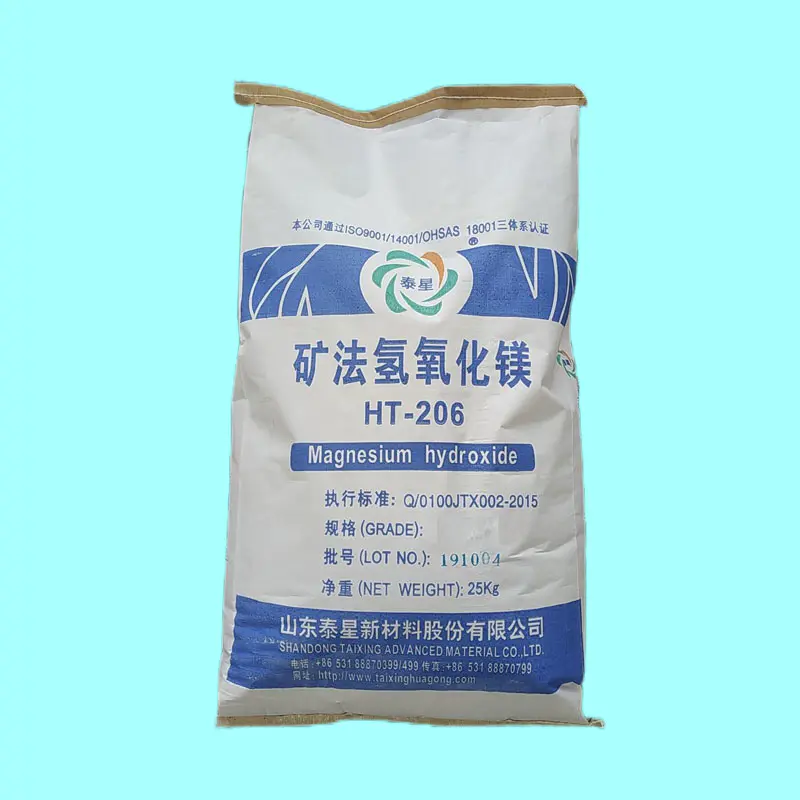
How Magnesium Hydroxide MDH improves fire ratings in TPEs
The fire resistance rating of a TPE compound depends largely on heat release rate, dripping behavior, and smoke density. Magnesium Hydroxide MDH addresses all three parameters. When exposed to temperatures above 330°C, it decomposes into magnesium oxide and water vapor. This reaction absorbs significant heat energy, slowing the thermal degradation of the TPE backbone. The released water vapor also reduces oxygen concentration at the combustion zone. Furthermore, the residual magnesium oxide layer forms a protective char that insulates the underlying material.
Performance comparison: TPE with and without Magnesium Hydroxide MDH
| Property | TPE without MDH | TPE with Magnesium Hydroxide MDH (60 phr) |
|---|---|---|
| UL 94 Rating | No rating | V-0 |
| Limiting Oxygen Index (LOI) | 19% | 32% |
| Peak Heat Release Rate | 850 kW/m² | 310 kW/m² |
| Smoke Density (Ds max) | 680 | 210 |
| Dripping behavior | Heavy flaming drips | No drips |
The data above, validated by Taixing internal testing, demonstrates that Magnesium Hydroxide MDH elevates LOI beyond 30%, a threshold for self-extinguishing materials. The absence of dripping is particularly valuable for wire and cable applications where flaming droplets can spread fire.
Mechanisms that enhance fire resistance ratings
Magnesium Hydroxide MDH contributes through three distinct modes:
-
Endothermic cooling: Approximately 1.3 kJ/g of heat absorbed during decomposition
-
Fuel dilution: Water vapor release reduces combustible volatile concentration
-
Barrier formation: MgO residue creates a ceramic-like shield against heat and oxygen
For thermoplastic elastomers based on SEBS, TPU, or TPO, Taixing recommends optimizing particle size distribution and surface coating of Magnesium Hydroxide MDH to maintain mechanical flexibility while achieving V-0 ratings.
Magnesium Hydroxide MDH FAQ
Question 1: What loading level of Magnesium Hydroxide MDH is typically required to achieve UL 94 V-0 in TPE compounds?
Answer: For most thermoplastic elastomers, Magnesium Hydroxide MDH loading between 55% and 65% by weight (approximately 120 to 180 phr) is necessary to achieve UL 94 V-0 at 1.6 mm thickness. The exact loading depends on the TPE base resin, plasticizer content, and presence of synergistic additives such as zinc borate or metal oxides. Taixing recommends starting at 60 phr and adjusting based on melt flow index and fire testing results. Higher loadings improve flame retardancy but may reduce elongation at break, so surface-treated grades of Magnesium Hydroxide MDH are preferred to preserve mechanical properties.
Question 2: Does Magnesium Hydroxide MDH affect the processability and surface finish of TPEs during extrusion or injection molding?
Answer: Yes, Magnesium Hydroxide MDH increases melt viscosity and can reduce surface gloss if not properly dispersed. However, Taixing offers micronized and coated Magnesium Hydroxide MDH grades that incorporate silane or stearic acid surface treatments. These treated grades significantly improve dispersion and maintain surface smoothness. For extrusion applications, a screw design with mixing elements and slightly higher processing temperatures (by 10-15°C) compensates for the increased viscosity. Surface finish remains acceptable for wire jacketing and gasket profiles when using Taixing high-purity Magnesium Hydroxide MDH with median particle size below 2.5 µm.
Question 3: Can Magnesium Hydroxide MDH be combined with other flame retardants to achieve higher fire resistance ratings at lower total loadings?
Answer: Absolutely. Magnesium Hydroxide MDH shows strong synergy with zinc borate, magnesium silicate, and red phosphorus. A combination of 45 phr Magnesium Hydroxide MDH and 10 phr zinc borate can achieve V-0 rating similar to 65 phr Magnesium Hydroxide MDH alone, while improving elongation by 40%. Taixing has developed proprietary blends where Magnesium Hydroxide MDH is paired with organoclays to reduce total additive loading by 25-30% without compromising LOI values. Synergistic systems also reduce smoke production and dripping more effectively than single-additive systems. Always test compatibility because certain synergists may affect heat aging resistance.
Ready to upgrade your TPE compounds with high-performance Magnesium Hydroxide MDH? Taixing provides technical datasheets, formulation guidance, and free samples for qualified projects. Reach out to our engineering team at Taixing to discuss your target fire resistance rating, processing conditions, and mechanical requirements. Let us help you achieve safer, compliant thermoplastic elastomers with the right Magnesium Hydroxide MDH solution.