
What Size Beaker Fits Best on a Square Plate Magnetic Stirrer
2026-08-27
Selecting the correct beaker size for a Square Plate Magnetic Stirrer is not merely about physical fit—it directly impacts stirring efficiency, sample safety, and equipment longevity. Unlike round-top stirrers, a Square Plate Magnetic Stirrer offers a flat, symmetrical platform that accommodates various vessel shapes, but the optimal beaker size depends on base diameter, liquid volume, and stir bar length. At DDKSCI, we have tested hundreds of configurations to help you match your glassware to the right Square Plate Magnetic Stirrer model.
Why Platform Shape Matters for Beaker Selection
The square plate provides four corner zones that distribute magnetic flux more evenly than circular designs. However, this advantage only works if the beaker’s bottom sits fully within the central magnetic field zone—typically the middle 70% of the plate surface. Placing a beaker too large extends beyond the drive magnet’s effective radius, causing poor coupling or erratic spinning. Conversely, a beaker too small may not engage the stir bar’s full length, reducing vortex depth.
| Beaker Size (mL) | Recommended Base Diameter (mm) | Max Liquid Volume for Stable Stirring | Ideal Stir Bar Length (mm) |
|---|---|---|---|
| 50 – 100 | 45 – 55 | 80 mL | 15 – 20 |
| 150 – 250 | 60 – 75 | 200 mL | 25 – 30 |
| 400 – 600 | 80 – 95 | 500 mL | 35 – 40 |
| 1000 | 100 – 115 | 800 mL | 45 – 50 |
| 2000 | 120 – 140 | 1500 mL | 55 – 65 |
Critical Fit Rules for Your Square Plate Magnetic Stirrer
Rule 1 – Base Diameter ≤ Plate Width × 0.85
If your Square Plate Magnetic Stirrer has a 180 mm × 180 mm plate, the maximum beaker base should not exceed 153 mm. Exceeding this shifts the center of mass outward, increasing wobble and noise.
Rule 2 – Liquid Height < 1.5 × Beaker Diameter
Tall, narrow beakers (e.g., 250 mL conical) create excessive hydrodynamic drag on the stir bar. For a Square Plate Magnetic Stirrer, wide-form beakers (like Berzelius or low-form Griffin) consistently outperform tall forms at the same volume.
Rule 3 – Stir Bar Length = 40–60% of Beaker Base Diameter
A 50 mm base works best with a 20–30 mm bar. Using a bar shorter than 40% causes weak vortex; longer than 60% may hit the beaker wall, damaging both the bar and the Square Plate Magnetic Stirrer’s drive magnet.
Practical Selection Workflow from DDKSCI
-
Measure your beaker’s external base – not the top rim.
-
Check your Square Plate Magnetic Stirrer’s technical spec for maximum stirring capacity (e.g., 5 L for DDKSCI’s SPS-200 model).
-
Match stir bar material – PTFE-coated bars are standard, but viscous samples (e.g., glycerol) require octagonal bars for better grip on the square plate’s magnetic field.
-
Test with water first – if the bar decouples above 600 RPM, downsize the beaker or increase bar length.
Common Mistakes to Avoid
-
Using a 2000 mL beaker on a 150 mm plate – the overhang creates torque imbalance.
-
Filling to the brim – leave at least 15% headspace to prevent splashing when the Square Plate Magnetic Stirrer starts.
-
Ignoring bottom flatness – round-bottom flasks require an adapter mat; otherwise, the stir bar spins eccentrically.
Square Plate Magnetic Stirrer FAQ
Q: Can I use an Erlenmeyer flask on a Square Plate Magnetic Stirrer?
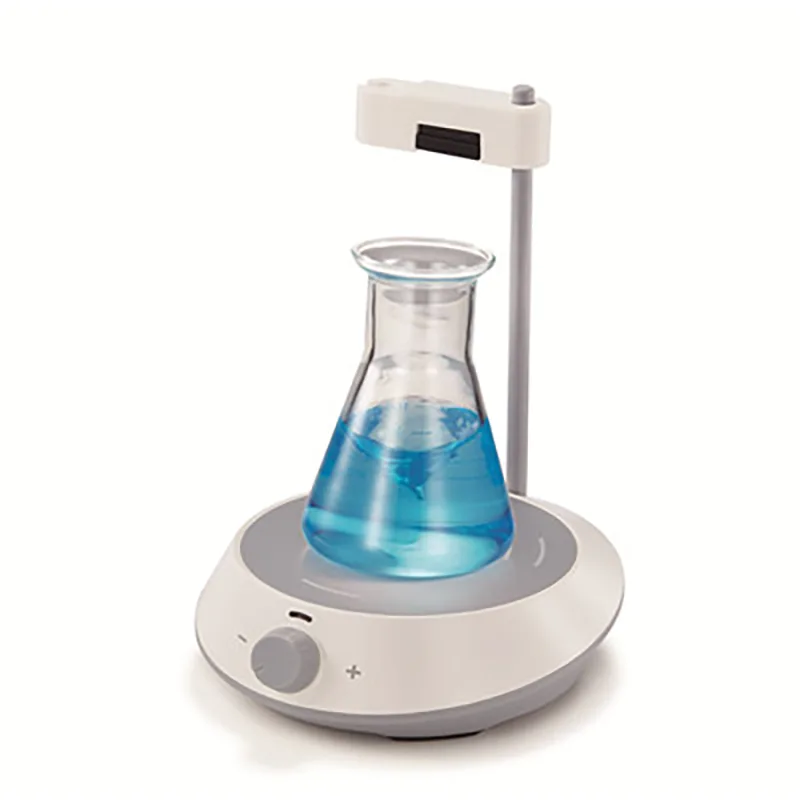
A: Yes, but only if the flask’s base diameter falls within 70–85% of the plate width. Erlenmeyer flasks have a narrower base than their nominal volume suggests—for example, a 500 mL Erlenmeyer typically has a 90 mm base, which fits a 180 mm square plate well. However, the angled walls reduce magnetic coupling efficiency by about 10–15% compared to flat-bottom beakers. DDKSCI recommends using a silicone pad to level the flask and always starting at 300 RPM to avoid bar decoupling.
Q: What happens if my beaker is too large for the Square Plate Magnetic Stirrer?
A: Three issues arise: (1) the stir bar may jump off-center because the magnetic field weakens near the plate edges, (2) the motor draws higher current to compensate, risking overheating in prolonged runs, and (3) the vortex becomes asymmetrical, leading to inconsistent mixing—especially critical in titration or cell culture media preparation. If you must use a large beaker, reduce the stirring speed by 30–40% and monitor the bar’s tracking visually. For vessels above 2 L, DDKSCI offers a separate overhead stirrer series.
Q: Does the shape of the beaker bottom affect stirring performance on a square plate?
A: Absolutely. Flat-bottom beakers provide the best magnetic coupling because the stir bar rests parallel to the plate’s magnet array. Conical or round-bottom vessels create an air gap underneath, reducing magnetic flux transfer by up to 25%. To remedy this, use a flat-bottom insert or a magnetic stirrer stand with adjustable height. For routine work, DDKSCI advises choosing low-form Griffin beakers for any Square Plate Magnetic Stirrer—they offer the largest flat contact area per volume, ensuring smooth, quiet operation even at 1500 RPM.
Final Recommendation
For most laboratories, a 400–600 mL flat-bottom beaker (80–95 mm base) is the “goldilocks” size for a standard 180 mm Square Plate Magnetic Stirrer. It accommodates 70% of daily mixing tasks—from buffer preparation to sample homogenization—while leaving enough plate surface for secondary vessels if needed.
Contact Us for a Custom Fit Assessment
Every application is unique, and the right beaker size also depends on your sample’s viscosity, temperature, and stirring duration. The DDKSCI technical team offers free plate-mapping consultations to match your glassware portfolio with the ideal Square Plate Magnetic Stirrer model. Reach out via our website or email us directly—we will send you a printable sizing template and a compatibility chart tailored to your lab’s existing beaker inventory. Contact DDKSCI today and let us help you stir with confidence, precision, and safety.