

Article Summary
Vonoprazan fumarate is the fumarate salt form of vonoprazan, a potassium-competitive acid blocker (PCAB) used to suppress gastric acid secretion. Unlike conventional proton-pump inhibitors that require activation in an acidic environment, vonoprazan directly and reversibly inhibits the gastric H+, K+-ATPase through potassium-competitive binding. This property has made the ingredient important in pharmaceutical formulations for conditions involving excessive or clinically relevant gastric acid secretion, including erosive esophagitis and, in combination regimens, Helicobacter pylori infection. For pharmaceutical buyers, however, understanding the ingredient requires more than knowing its chemical name. Salt form, identity, assay, impurity profile, analytical documentation, packaging, storage, batch consistency, and regulatory documentation all matter when evaluating a supply source. This article explains the ingredient from both a pharmaceutical and procurement perspective without treating a raw-material specification as a substitute for finished drug approval or medical advice.
What Does Vonoprazan Fumarate Represent?
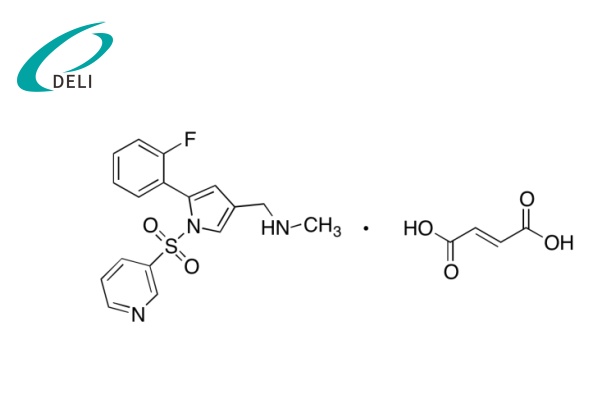
Vonoprazan fumarate is a pharmaceutical salt form of vonoprazan. It belongs to the potassium-competitive acid blocker class and acts on the gastric proton pump responsible for the final stage of acid secretion. The U.S. FDA identifies vonoprazan, supplied as the fumarate, as a potassium-competitive acid blocker. The fumarate form has the molecular formula C17H16FN3O2S·C4H4O4 and a molecular weight of approximately 461.5 g/mol.
From a pharmaceutical-material perspective, the distinction between the active moiety and the salt form is important. A procurement specification may refer specifically to Vonoprazan Fumarate, while regulatory documentation for a finished dosage form may express strength in terms of vonoprazan. For example, U.S. labeling lists tablets containing 10 mg or 20 mg of vonoprazan, corresponding to 13.36 mg and 26.72 mg of vonoprazan fumarate, respectively.
This distinction becomes particularly useful during purchasing, formulation development, analytical testing, and document review. A supplier and buyer should agree on exactly which form, strength basis, specification, and test methods are being quoted before a commercial order is finalized.
How Does Vonoprazan Fumarate Work?
Gastric acid is produced by specialized parietal cells in the stomach. The final step in this process depends on the H+, K+-ATPase, commonly called the gastric proton pump. Vonoprazan suppresses basal and stimulated acid secretion by competitively inhibiting potassium binding at this enzyme system.
This mechanism is different in an important way from traditional acid-suppressing proton-pump inhibitors. Vonoprazan does not need to be converted into an active form by an acidic environment before it can interact with the proton pump. FDA clinical pharmacology information describes it as binding reversibly and noncovalently to active proton pumps and acting through potassium competition.
The practical significance of the mechanism
For formulation and pharmaceutical research, the mechanism helps explain why vonoprazan has become a distinct option within acid-suppression therapy. Its activity is directed toward the final stage of gastric acid secretion rather than simply modifying an upstream signaling process.
In H. pylori eradication regimens, acid suppression also has a supporting role: raising gastric pH can influence the activity and stability of accompanying antimicrobial therapy. The exact regimen, however, depends on the approved product, jurisdiction, patient characteristics, and prescribing information.
Where Is Vonoprazan Fumarate Used in Pharmaceutical Development?
The clinical applications of vonoprazan vary by country and product authorization. In the United States, FDA-approved uses include healing of erosive esophagitis, maintenance of healed erosive esophagitis, and treatment of H. pylori infection in adults when used in specified combination regimens.
The ingredient can therefore appear in pharmaceutical development programs involving gastric acid suppression and combination treatment. Buyers working with the material should not assume that a product indication in one market automatically applies in another. Regulatory status should always be checked against the intended destination market.
| Application Area | Role of Vonoprazan | Procurement Consideration |
|---|---|---|
| Erosive esophagitis products | Acid suppression through PCAB activity | Confirm assay, impurities and dosage-form requirements |
| H. pylori combination products | Acid suppression used alongside specified antimicrobials | Review the exact regulatory formulation and market requirements |
| Pharmaceutical R&D | Active pharmaceutical ingredient for formulation studies | Consistent analytical profile and batch-to-batch quality are essential |
| Analytical research | Reference or test material depending on the project | Identity, purity, storage and analytical documentation should be clear |
What Characteristics Should Be Reviewed?
A pharmaceutical buyer should look beyond a single purity figure. Vonoprazan fumarate is described by the FDA as a white to nearly white crystalline powder. It is soluble in dimethyl sulfoxide, sparingly soluble in several polar organic solvents, and only slightly soluble in water. Such information can be useful during formulation design, analytical method development, and material handling.
Identity and chemical form
The first checkpoint is whether the supplied material is actually the specified fumarate salt rather than another form or an incorrectly named material. Identity testing should be supported by an appropriate analytical method and accompanied by a clear certificate of analysis.
Assay and purity
Assay indicates the quantity of the target substance measured according to the stated analytical method. Purity specifications should be considered together with related substances, degradation products, residual solvents, water content and other relevant parameters rather than viewed as one isolated number.
Physical characteristics
Particle characteristics can become relevant when the material is incorporated into a solid dosage form. Depending on the formulation process, particle-size distribution, morphology, flow behavior and bulk characteristics may affect blending and processing. These parameters should be defined according to the customer's actual formulation needs rather than added arbitrarily to a specification.
What Should Buyers Check Before Purchasing?
Pharmaceutical raw-material purchasing has a different risk profile from ordinary chemical trading. A material can have the correct commercial name and still require further verification before it is suitable for a particular development or manufacturing program.
- Confirm the exact substance. Make sure the quotation identifies vonoprazan fumarate and clearly states the chemical form, specification basis and intended use.
- Review the Certificate of Analysis. Compare assay, identification, related substances, residual solvents, water content and other agreed parameters with the customer's specification.
- Check analytical methods. A numerical result is more meaningful when the testing method, acceptance criterion and reporting units are clearly documented.
- Evaluate batch consistency. Buyers planning recurring procurement should examine whether different batches show stable results rather than evaluating only one sample.
- Clarify packaging. Pharmaceutical ingredients can be sensitive to environmental exposure, so packaging configuration and sealing should be agreed before shipment.
- Confirm traceability. Batch numbers, manufacturing information and documentation should allow the supplied material to be traced through the supplier's quality system.
| Buyer Question | Why It Matters |
|---|---|
| Is the material specifically vonoprazan fumarate? | Prevents confusion between active moiety and salt-form specifications. |
| What is the current specification? | Allows the buyer to compare material against the intended application. |
| Can a batch-specific COA be provided? | Supports technical review and incoming quality control. |
| Are impurity and residual-solvent limits documented? | These can be important quality attributes for pharmaceutical development. |
| Can samples be supplied before bulk purchase? | Allows analytical and formulation teams to evaluate the material. |
Why Do Documentation and Batch Traceability Matter?
For pharmaceutical raw materials, technical documents are part of the purchasing decision rather than an afterthought. The exact document package required can differ according to the buyer's quality system, intended market and regulatory pathway.
A professional inquiry should therefore cover more than price and available quantity. Buyers may need a current specification, batch-specific COA, analytical information, manufacturing details and other quality documents applicable to their project.
A practical document checklist
- Product specification
- Batch-specific Certificate of Analysis
- Identity and assay test information
- Related-substance or impurity profile
- Residual-solvent information where applicable
- Water or moisture specification where applicable
- Packaging and storage information
- Batch number and traceability information
- Applicable quality or regulatory documents requested by the buyer
The purpose is not to collect documents for their own sake. The goal is to create a traceable connection between the material ordered, the batch tested, the specification agreed, and the pharmaceutical process in which the ingredient will be evaluated.
How Should Storage and Handling Requirements Be Considered?
Storage conditions should follow the supplier's validated recommendations and the applicable product documentation. Buyers should pay attention to container integrity, moisture exposure, temperature conditions, labeling and transportation controls.
Bulk procurement also requires practical planning. A supplier may quote a material that meets the analytical specification, but the commercial result can still be affected by unsuitable packaging, unclear labeling, damaged containers or inconsistent batch identification.
Before shipment, the buyer and supplier should agree on packaging quantity, container type, labeling information, batch identification, storage instructions and any special transportation requirements relevant to the material.
Why Does Consistent Vonoprazan Fumarate Supply Matter?
For pharmaceutical manufacturers and R&D teams, the most useful supplier is not necessarily the one offering a single attractive quotation. Long-term material management depends on repeatable specifications, clear documentation and communication when production or quality parameters change.
Deli can support pharmaceutical buyers evaluating Vonoprazan Fumarate by focusing the sourcing discussion around the material specification, required documentation, packaging configuration, batch requirements and intended application. This approach helps technical and purchasing teams establish the requirements before moving from sample evaluation to larger-volume procurement.
For buyers comparing pharmaceutical ingredient suppliers, the key question is not simply whether Vonoprazan Fumarate is available. It is whether the material specification, analytical evidence, documentation and supply arrangement fit the requirements of the intended pharmaceutical project.
Frequently Asked Questions About Vonoprazan Fumarate
1. Is vonoprazan fumarate the same as vonoprazan?
Vonoprazan is the active moiety, while vonoprazan fumarate is the fumarate salt form. Pharmaceutical labeling may express the finished dosage strength as vonoprazan while the raw material specification identifies the supplied substance as vonoprazan fumarate.
2. What pharmacological class does vonoprazan belong to?
Vonoprazan belongs to the potassium-competitive acid blocker class. It suppresses gastric acid secretion by inhibiting the H+, K+-ATPase system in gastric parietal cells.
3. What is vonoprazan fumarate used for?
Approved uses depend on the market and product. In the United States, vonoprazan products are approved for specified uses involving erosive esophagitis and H. pylori infection in adults. Buyers should verify the applicable authorization for the destination market.
4. Does vonoprazan require an acidic environment for activation?
No. FDA clinical pharmacology information states that vonoprazan does not require activation by acid and inhibits the proton pump through potassium-competitive, reversible binding.
5. What should I request when buying Vonoprazan Fumarate?
At minimum, buyers should clarify the exact chemical form, specification, assay, impurity requirements, analytical methods, batch-specific COA, packaging, storage conditions and applicable quality documentation before placing an order.
6. Can Vonoprazan Fumarate be used directly as a finished medicine?
A pharmaceutical raw material should not be confused with an approved finished dosage form. Its suitability for formulation depends on the applicable quality specification, manufacturing process, regulatory requirements and finished-product controls.
7. Is a high assay value enough to evaluate a supplier?
No. Assay is only one part of pharmaceutical material quality. Related substances, residual solvents, identity, physical characteristics, documentation, traceability and batch consistency may also need to be evaluated according to the buyer's specification.
8. Can Deli provide information for Vonoprazan Fumarate sourcing?
Buyers can contact Deli with their required specification, quantity, packaging requirements and documentation needs. Providing these details at the inquiry stage allows the supply discussion to be aligned with the intended pharmaceutical project.
Need a Reliable Vonoprazan Fumarate Supply Discussion?
If your pharmaceutical project requires Vonoprazan Fumarate, send Deli your target specification, required quantity, packaging preference and documentation requirements. Our team can discuss the material details with your purchasing and technical teams and help establish a clear supply specification before sampling or bulk procurement.
Contact Us