

Sodium hypophosphite, commonly represented by the formula NaH2PO2, is an important inorganic phosphorus compound valued for its reducing properties, water solubility, and versatility in industrial chemistry. It is frequently encountered as sodium hypophosphite monohydrate, NaH2PO2·H2O, while the anhydrous material is also known as sodium phosphinate. The terms “hydrate,” “monohydrate,” and “dihydrate” can create confusion during sourcing because hydration state affects molecular weight, active-material calculations, storage behavior, formulation, and purchasing specifications.
This guide explains the differences that matter when evaluating sodium hypophosphite products, including chemical identity, hydration state, purity, solubility, handling, industrial applications, quality considerations, and purchasing requirements. It also explains why the monohydrate form is widely encountered and how buyers can avoid common specification mistakes. For industrial users, understanding the exact grade and hydration state is essential for consistent processing and reliable results.
Understanding the Chemical Identity of Sodium Hypophosphite
Sodium hypophosphite is the sodium salt of hypophosphorous acid and is also referred to as sodium phosphinate. Its anhydrous chemical formula is NaH2PO2, with a molecular weight of approximately 87.98 g/mol. In commercial and laboratory applications, however, sodium hypophosphite is very commonly supplied as the monohydrate, NaH2PO2·H2O, which has a molecular weight of approximately 105.99 g/mol.
This distinction is not simply a naming issue. The water molecule incorporated into a crystalline hydrate contributes to the product's molecular weight and therefore changes the mass required when preparing solutions or calculating stoichiometric quantities.
When a specification says “sodium hypophosphite,” always verify whether the intended material is anhydrous NaH2PO2 or sodium hypophosphite monohydrate. The two forms should not automatically be treated as interchangeable on a mass-for-mass basis.
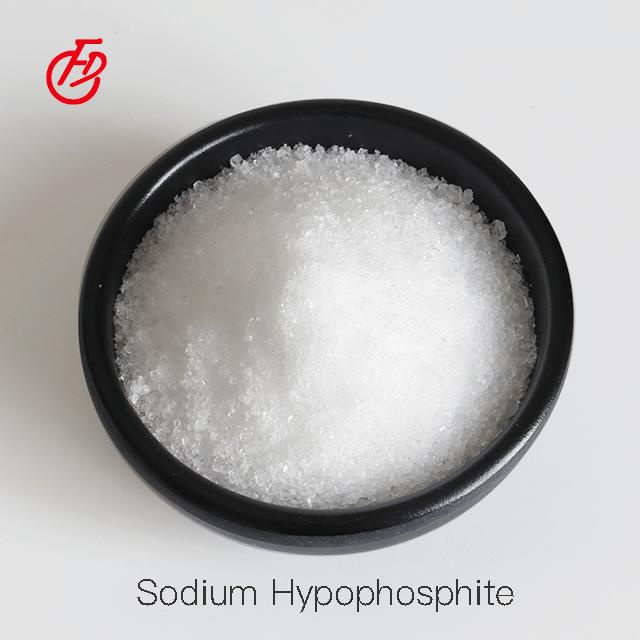
Sodium hypophosphite monohydrate is generally supplied as white crystals, powder, or chunks and is highly soluble in water. Commercial references commonly identify the monohydrate with CAS No. 10039-56-2, while anhydrous sodium hypophosphite is associated with CAS No. 7681-53-0.
How Hydration State Changes the Product
The word “hydrate” indicates that water is incorporated into the crystalline structure of a chemical compound. A monohydrate contains one molecule of water per formula unit. The phrase “dihydrate” would indicate two water molecules per formula unit. These forms can have different molecular weights and potentially different physical behavior.
| Material description | Formula | Approx. molecular weight | Practical consideration |
|---|---|---|---|
| Anhydrous sodium hypophosphite | NaH2PO2 | 87.98 g/mol | Requires anhydrous-material calculations |
| Sodium hypophosphite monohydrate | NaH2PO2·H2O | 105.99 g/mol | Widely encountered commercial form |
| Dihydrate terminology | NaH2PO2·2H2O | Depends on verified chemical identity | Should be confirmed against supplier documentation |
One common source of confusion is treating every appearance of the word “hydrate” as a separate commercial grade. In practice, buyers should rely on the stated formula, CAS number, assay basis, certificate of analysis, and product specification rather than a shortened product title alone.
For this reason, a professional purchasing request should specify the exact form required. If the process has been developed around NaH2PO2·H2O, replacing it with an anhydrous grade without recalculating the dosage can introduce avoidable formulation errors.
Key Properties That Matter in Practice
Sodium hypophosphite is particularly valuable because several useful characteristics come together in one material. It is a water-soluble inorganic salt with reducing capability, making it useful in both industrial surface treatment and chemical synthesis. Recent scientific literature continues to describe sodium hypophosphite as a versatile phosphorus reagent and reducing agent.
1. High Water Solubility
Water solubility is one of the most important practical characteristics for solution-based processes. Commercial sodium hypophosphite monohydrate specifications commonly describe it as readily soluble in water, with clear aqueous solutions obtainable at appropriate concentrations.
2. Reducing Capability
The low oxidation state of phosphorus gives hypophosphite its useful reducing behavior. This is particularly important in electroless metal deposition, where sodium hypophosphite can serve as the reducing agent responsible for converting metal ions into deposited metal.
3. Hygroscopic Behavior
Sodium hypophosphite can absorb moisture from the surrounding environment. Hygroscopicity matters because excessive moisture exposure may affect material handling, weighing, packaging integrity, and the consistency of concentrated formulations.
4. Purity and Impurity Control
For sensitive applications, simply purchasing a product labeled “sodium hypophosphite” may not be enough. Trace metals, chloride, sulfate, phosphite, insoluble matter, and other impurities can influence downstream performance, especially in plating and high-precision chemical processes.
5. Molecular-Weight Accuracy
Hydration state directly affects molecular-weight calculations. This becomes especially important when a process recipe is expressed in moles, phosphorus equivalents, or active-material concentration rather than simply kilograms of commercial product.
Where Sodium Hypophosphite Is Used
The versatility of sodium hypophosphite explains why it appears across several industrial and chemical fields. Its applications include surface treatment, metal finishing, chemical synthesis, specialty materials, and other processes where controlled reduction or phosphorus chemistry is required.
- Electroless nickel plating
- Specialty metal deposition processes
- Chemical synthesis and reduction reactions
- Preparation of phosphorus-containing compounds
- Specialty chemical formulations
- Research and laboratory applications
- Selected water-treatment and industrial chemical processes
Recent research has also highlighted sodium hypophosphite in organic synthesis, including applications involving reduction, phosphorus transfer, hydrogen donation, and related transformations.
This broad application range means that the best product specification depends heavily on the customer's actual process. A grade suitable for general chemical synthesis may not necessarily be the best choice for precision electroless plating.
Why Sodium Hypophosphite Matters in Electroless Nickel Plating
One of the most established industrial uses of sodium hypophosphite is electroless nickel plating. Unlike conventional electroplating, electroless deposition does not depend on an external electrical current to drive metal deposition. Instead, a chemical reducing agent supplies the electrons needed for the reduction of nickel ions.
Sodium hypophosphite is particularly valuable in this role because it can participate in the reduction process and contribute to the formation of nickel-phosphorus deposits. The resulting coating can provide useful combinations of corrosion resistance, hardness, wear performance, and uniform coverage depending on the formulation and process conditions.
This is especially useful for complex geometries. Components containing recesses, internal surfaces, edges, or irregular shapes can be difficult to coat uniformly using conventional current-dependent methods. Electroless processing can provide more consistent coverage when the bath chemistry and operating conditions are properly controlled.
Process factors that deserve attention
- Bath concentration and chemical balance
- Temperature control
- pH management
- Nickel-ion concentration
- Hypophosphite concentration
- Accumulation of reaction by-products
- Contamination and trace-metal control
- Bath age and replenishment strategy
A consistent sodium hypophosphite raw material can therefore be an important part of maintaining repeatable plating performance. Small changes in impurity levels or active concentration may become more significant when the material is consumed continuously in a production bath.
How to Evaluate Sodium Hypophosphite Quality
Product quality should be evaluated against the application rather than judged by appearance alone. White crystals may indicate the expected physical appearance, but visual inspection cannot establish assay, hydration state, or trace impurity levels.
Check the Certificate of Analysis
A useful certificate of analysis should identify the product and provide relevant test results. Depending on the application, buyers may request assay, moisture or loss-on-drying, insoluble matter, chloride, sulfate, phosphite, iron, heavy metals, and other parameters.
Confirm the CAS Number
CAS identification is particularly useful when several naming conventions are being used. Sodium hypophosphite monohydrate is commonly listed as CAS 10039-56-2, while anhydrous sodium hypophosphite is associated with CAS 7681-53-0.
Verify the Assay Basis
Ask whether the stated assay refers to the commercial hydrate as supplied or to an anhydrous-equivalent basis. This small detail can prevent substantial discrepancies during formulation and cost calculations.
Evaluate Packaging
Since sodium hypophosphite can absorb moisture, packaging should provide suitable protection against humidity. The correct packaging also depends on transportation distance, warehouse conditions, package size, and expected storage duration.
| Quality checkpoint | Why it matters |
|---|---|
| Chemical formula | Confirms the intended material and hydration state |
| CAS number | Reduces ambiguity between related forms |
| Assay | Helps calculate effective active material |
| Moisture | Important for storage and formulation consistency |
| Trace impurities | Important for sensitive industrial processes |
| Particle/physical form | Affects handling, dissolution, and feeding |
| Packaging | Protects the product during storage and transport |
Storage and Handling Considerations
Proper storage is essential for maintaining the consistency of sodium hypophosphite. Because the material can absorb moisture, containers should remain tightly closed and the product should be protected from humid environments. Published technical information recommends cool, dry storage and separation from incompatible oxidizing materials.
Good warehouse practice should include clean, dry storage areas, intact packaging, appropriate labeling, and procedures that minimize unnecessary exposure to ambient air.
- Keep containers tightly closed when not in use.
- Store in a cool, dry, well-controlled environment.
- Protect the material from excessive humidity.
- Keep away from incompatible strong oxidizing materials.
- Use appropriate personal protective equipment when handling bulk material.
- Follow the supplier's current SDS and local workplace safety requirements.
Heating should also be approached carefully. Technical references indicate that sodium hypophosphite can undergo decomposition under sufficiently severe conditions, with phosphine formation being an important safety consideration.
How to Build a Reliable Purchasing Specification
Buyers often focus heavily on price per kilogram, but the lowest quoted price is not necessarily the lowest process cost. A more useful purchasing specification connects the raw material to the customer's actual production requirements.
A well-prepared inquiry should include the following information:
- Exact chemical name: State sodium hypophosphite clearly.
- Formula: Specify NaH2PO2 or NaH2PO2·H2O as required.
- Hydration state: Confirm whether anhydrous or monohydrate material is required.
- Purity: Define the minimum assay and any critical impurity limits.
- Application: Explain whether the product is intended for plating, synthesis, research, or another process.
- Packaging: Specify preferred package size and moisture-protection requirements.
- Documentation: Request a COA and SDS appropriate to the intended market.
- Batch consistency: For recurring orders, establish consistent quality requirements.
For companies purchasing sodium hypophosphite repeatedly, working with a knowledgeable supplier can also simplify batch-to-batch quality control. TitanChem Inorganics Co., Ltd can be positioned as a sourcing partner for customers who need clear product specifications and dependable communication around inorganic chemical requirements.
Do not compare two quotations solely by the product name and price. First compare formula, hydration state, assay, impurity specifications, packaging, documentation, and delivery conditions. A seemingly cheaper material may not have the same active-material basis or quality specification.
Frequently Asked Questions About Sodium Hypophosphite
Is sodium hypophosphite the same as NaH2PO2?
NaH2PO2 is the chemical formula for anhydrous sodium hypophosphite. In commercial use, the material is frequently supplied as sodium hypophosphite monohydrate, NaH2PO2·H2O. The hydration state should therefore be confirmed before making formulation or purchasing calculations.
What is sodium hypophosphite monohydrate?
Sodium hypophosphite monohydrate is sodium hypophosphite containing one molecule of crystallization water per formula unit. Its commonly listed formula is NaH2PO2·H2O and its molecular weight is approximately 105.99 g/mol.
Why is sodium hypophosphite used in electroless nickel plating?
It functions as a reducing agent in the chemical deposition of nickel and is an established component of electroless nickel-plating chemistry. Its reducing behavior enables metal ions to be converted into deposited metal without relying on an external electrical current.
Does hydration state affect dosage?
Yes. Hydration adds mass without changing the underlying sodium hypophosphite ion itself. Therefore, a dosage calculated on a molar or active-material basis must account for whether the material is anhydrous or monohydrate.
Is sodium hypophosphite soluble in water?
Yes. Sodium hypophosphite is highly water-soluble, which is one reason it is convenient for aqueous industrial processes. Published data and commercial specifications both identify strong water solubility.
How should sodium hypophosphite be stored?
It should generally be kept tightly closed in a cool, dry environment and protected from excessive humidity and incompatible oxidizing materials. Always follow the current supplier SDS and site-specific handling procedures.
What should industrial buyers check before ordering?
Buyers should confirm the chemical formula, hydration state, CAS number, assay, impurity limits, physical form, packaging, COA, SDS, and intended application. These details provide a much stronger basis for comparison than the product name alone.
Why can the terms hydrate, monohydrate, and dihydrate cause confusion?
“Hydrate” is a general description, while “monohydrate” and “dihydrate” indicate specific amounts of crystallization water. Because hydration affects molecular weight and potentially physical characteristics, the exact formula should always be confirmed before purchasing or formulating.
Making the Right Sodium Hypophosphite Specification
Sodium hypophosphite is a relatively simple compound chemically, but selecting the right commercial material requires attention to details that can have a major impact on production. The most important starting point is to distinguish anhydrous NaH2PO2 from the widely encountered monohydrate NaH2PO2·H2O.
From there, buyers should look beyond the product name and evaluate assay, impurities, physical form, packaging, documentation, and application requirements. This is particularly important for electroless nickel plating and other processes where raw-material consistency directly affects bath behavior and finished-product quality.
By establishing a precise specification before purchasing, industrial users can reduce formulation errors, improve batch consistency, simplify incoming inspection, and make supplier comparisons much more meaningful. For customers seeking dependable inorganic chemical supply and application-oriented support, TitanChem Inorganics Co., Ltd can help clarify product requirements and sourcing details.
Need a Reliable Sodium Hypophosphite Supply?
Looking for sodium hypophosphite with clearly defined specifications, consistent quality, and professional supply support? Connect with TitanChem Inorganics Co., Ltd to discuss your application, required grade, packaging, and purchasing needs.
Have questions about sodium hypophosphite? Please contact us for product information and a tailored solution.