

Why Are Food Safety Test Kits Critical for Grain and Feed Quality Control?
2026-09-10
1. What Are the Primary Safety Risks in Grain and Feed Production?
Grain and feed are vulnerable to three categories of contaminants: biological, chemical, and physical. The most significant biological risk is mycotoxins—toxic compounds produced by molds that grow on grain under adverse weather conditions. Aflatoxin, deoxynivalenol (DON), zearalenone, and fumonisin are the most common mycotoxins found in corn, wheat, and barley. Chemical risks include pesticide residues, heavy metals (lead, cadmium, arsenic), and industrial pollutants. Physical risks include stones, metal fragments, and plastic debris.
The table below summarizes the primary risks and their typical allowable limits in animal feed and human food.
| Contaminant | Typical grain affected | Regulatory limit (feed) | Regulatory limit (food) | Health impact |
| Aflatoxin B1 | Corn, peanuts, cottonseed | 20 ppb (EU) | 2 ppb (EU) | Liver cancer, immunosuppression |
| Deoxynivalenol (DON) | Wheat, barley, corn | 5,000 ppb (EU guidance) | 750 ppb (EU) | Feed refusal, vomiting, weight loss |
| Zearalenone | Corn, wheat | 500 ppb (EU guidance) | 75 ppb (EU) | Reproductive disorders in livestock |
| Fumonisin | Corn | 10,000 ppb (EU guidance) | 1,000 ppb (EU) | Esophageal cancer, neural tube defects |
| Lead | All grains | 10 ppm | 0.2 ppm | Neurological damage, kidney damage |
| Cadmium | Wheat, rice | 2 ppm | 0.2 ppm | Kidney damage, bone disease |
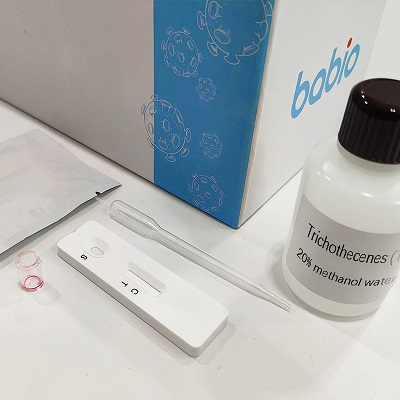
In our factory, we manufacture Food safety test kit products for the rapid detection of all these contaminants. Our kits are designed for use at the point of receipt, in the warehouse, or in the production line. The results are available within 10 to 20 minutes, allowing immediate decisions.
2. Why Are Traditional Laboratory Methods Insufficient for Grain and Feed Operations?
Traditional laboratory methods for mycotoxin detection, such as HPLC (high-performance liquid chromatography) and LC-MS/MS (liquid chromatography-tandem mass spectrometry), are highly accurate and sensitive. They are the reference methods for regulatory compliance. However, they have three limitations that make them unsuitable for routine quality control in grain and feed operations. The first is time. A laboratory test takes 3 to 5 days from sample submission to result. The second is cost. A single mycotoxin test by LC-MS/MS costs $100 to $300. The third is accessibility. The equipment requires a dedicated laboratory with trained personnel. For a grain elevator that receives 50 trucks per day, sending every load to an external laboratory is impractical. Food safety test kits fill this gap by providing rapid, on-site screening at a fraction of the cost.
Time and cost comparison: A Food safety test kit for aflatoxin costs $5 to $15 per test and provides results in 15 minutes. An LC-MS/MS test costs $150 and takes 3 to 5 days. For routine screening, the test kit is the only practical option. Positive results can then be confirmed by laboratory analysis.
Jinan Babio Biotechnology Co., Ltd. has been developing and manufacturing Food safety test kit products for over 12 years. Our kits are used by grain elevators, feed mills, and food processing plants in more than 40 countries.
3. What Are the Key Performance Parameters for Selecting a Food Safety Test Kit?
When selecting a Food safety test kit for grain and feed quality control, the quality control manager must evaluate five key parameters: sensitivity, specificity, recovery rate, assay time, and sample preparation complexity. The table below explains these parameters and their typical values for our products.
| Parameter | Definition | Typical value for our kits | Why it matters |
| Sensitivity (LOD) | Lowest concentration that can be reliably detected | 1 – 5 ppb for aflatoxin | Must be below the regulatory limit |
| Specificity | Ability to detect the target without cross-reactivity | < 5% cross-reactivity with similar compounds | Prevents false positives |
| Recovery rate | Percentage of target recovered from spiked samples | 80 – 120% | Indicates accuracy of the extraction method |
| Assay time | Time from sample addition to result | 10 – 20 minutes | Determines throughput in receiving operations |
| Sample preparation | Steps required to prepare the sample | Grind, extract, filter, dilute | Simpler is better for field use |
Our Food safety test kit products are based on lateral flow immunochromatography, which is the most widely used technology for rapid mycotoxin screening. The test strip contains specific antibodies that bind to the target toxin. A colored line appears when the toxin is present. The intensity of the line is proportional to the concentration, which can be read visually or with a portable reader.
4. How Do Rapid Test Kits Integrate Into the Quality Control Workflow?
The most effective way to use a Food safety test kit in grain and feed operations is to integrate it into a three-stage workflow: incoming material screening, in-process monitoring, and finished product verification. At the receiving stage, a sample is taken from each truck or railcar. The sample is ground and extracted, and the test kit is run. If the result is negative (below the limit), the load is accepted. If the result is positive, the load is quarantined for laboratory confirmation. At the in-process stage, samples are taken from the production line at regular intervals to monitor for contamination. At the finished product stage, a final test is performed before shipment. This three-stage approach provides comprehensive protection and documentation for regulatory audits.
Frequently Asked Questions About Food Safety Test Kits for Grain and Feed
Summary for Quality Control Managers
Food safety test kits are critical tools for grain and feed quality control because they provide rapid, on-site results that allow immediate decisions at the point of receipt. They are not a replacement for laboratory confirmation, but they are an essential screening tool that protects the supply chain from contaminated material. The key to effective use is to select a kit with the right sensitivity and specificity for your target contaminants, and to integrate it into a three-stage workflow. Our factory has been manufacturing Food safety test kit products for over 12 years, and we provide full technical support and validation data for our customers.
Jinan Babio Biotechnology Co., Ltd. manufactures Food safety test kit products for mycotoxins, heavy metals, and pesticide residues. We provide training, technical support, and customized kit configurations for grain and feed applications.