

Why Choose Aluminum Hypophosphite for Flame Retardant Applications?
2025-11-28
At Shandong Taixing Advanced Material Co., Ltd., we have always prioritized innovation and reliability in chemical materials. Aluminum Hypophosphite has emerged as a leading flame retardant additive in the plastics and coatings industry. Its unique chemical properties not only enhance fire resistance but also ensure stability, low smoke emission, and environmental compliance. I often ask myself how such a small additive can have such a profound impact on material safety, and the answer always points to its excellent thermal stability and decomposition behavior.
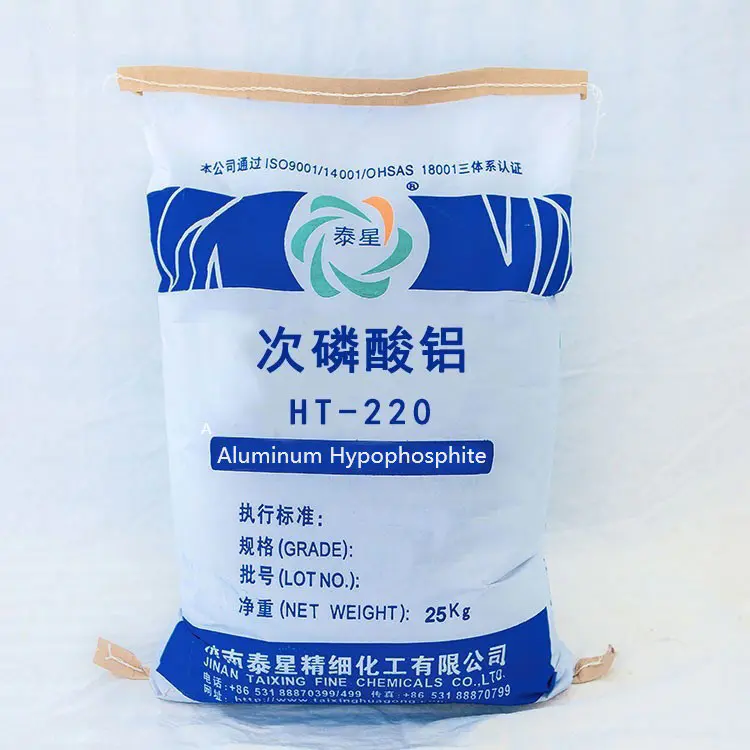
What is Aluminum Hypophosphite?
Aluminum Hypophosphite (AlH₂PO₂) is a white, crystalline powder widely used as a flame retardant and synergist in polymer materials. Its chemical stability, low toxicity, and high efficiency make it ideal for various industrial applications.
Key Properties of Aluminum Hypophosphite:
| Property | Specification |
|---|---|
| Chemical Formula | Al(PO₂H₂)₃ |
| Appearance | White crystalline powder |
| Purity | ≥ 99% |
| Particle Size | 5–50 μm |
| Thermal Decomposition Temp. | 200–250°C |
| Solubility | Slightly soluble in water |
| Application | Flame retardant for plastics, coatings, textiles |
What are the Main Functions of Aluminum Hypophosphite?
-
Flame Retardant Action – It releases phosphine compounds upon heating, forming a protective char layer that prevents oxygen from sustaining combustion.
-
Synergistic Effect – Often used with other halogen-free flame retardants to improve efficiency in polymers like PVC, epoxy, and polyethylene.
-
Thermal Stability – Maintains structure at elevated temperatures, reducing smoke and toxic gas emissions.
-
Environmental Safety – Halogen-free and low-toxicity, meeting modern environmental standards.
I often wonder how our clients can maximize the efficiency of Aluminum Hypophosphite in their products. The answer lies in precise formulation and particle size selection, which we at Shandong Taixing Advanced Material Co., Ltd. can assist with through tailored technical support.
How Does Aluminum Hypophosphite Work in Polymers?
When incorporated into polymer matrices, Aluminum Hypophosphite decomposes under heat to produce phosphinic acid and phosphine. These compounds catalyze char formation and reduce combustible gases. The result is significantly improved fire resistance and reduced smoke emission.
Benefits in Applications:
-
Plastics: Enhances flame retardancy of PVC, PE, and engineering plastics.
-
Coatings: Provides durable flame protection for paints and varnishes.
-
Textiles: Improves safety of fabrics without compromising flexibility.
I often get asked by our partners, "Can Aluminum Hypophosphite affect mechanical properties?" Proper dosing and uniform dispersion ensure that material strength and flexibility remain intact while achieving high flame retardancy.
Why is Aluminum Hypophosphite Important for Modern Industry?
With stricter environmental regulations and increasing demand for safer materials, Aluminum Hypophosphite offers a reliable, halogen-free solution for manufacturers. Its combination of safety, efficiency, and environmental compliance makes it indispensable for:
-
Electronics and electrical appliances
-
Building materials and insulation
-
Automotive components
Key Advantages Summary:
-
Halogen-free, environmentally friendly
-
Efficient flame retardant at low loadings
-
Reduces smoke and toxic gas release
-
Compatible with various polymers and coatings
At Shandong Taixing Advanced Material Co., Ltd., we are committed to providing high-quality Aluminum Hypophosphite that meets international standards. Our products are supported by detailed technical datasheets and professional application guidance. If you are looking to enhance the flame retardancy of your materials while ensuring safety and compliance, contact us today to discuss your specific requirements.