

Why Do Active Ingredients Interact Differently in Various Formulations?
2026-01-22
Understanding why active ingredients behave differently in diverse Formulations is critical for developing effective pharmaceutical and chemical products. At SANDOO PHARMACEUTICALS AND CHEMICALS CO.,LTD., our research focuses on identifying the unique interactions that affect product stability, efficacy, and safety. Our factory ensures that each ingredient is carefully tested to achieve optimal performance in specific applications.
How Do Chemical Properties Influence Ingredient Performance?
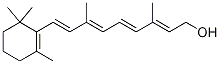
The chemical structure of active ingredients plays a pivotal role in determining their behavior in Formulations. Polar and non-polar compounds, solubility in various solvents, and molecular stability all affect the rate of reaction and shelf-life. At SANDOO PHARMACEUTICALS AND CHEMICALS CO.,LTD., our team analyzes each component using advanced spectroscopy and chromatography to understand its compatibility with other ingredients. Our approach ensures that our products maintain consistent quality across batches.
| Ingredient | Polarity | Solubility | Stability |
| Compound A | High | Water soluble | Stable under neutral pH |
| Compound B | Medium | Soluble in ethanol | Degrades in acidic conditions |
| Compound C | Low | Oil soluble | Heat sensitive |
Our testing methods allow us to predict how these ingredients will interact in different Formulations. Our factory uses this data to create blends that maximize efficacy while minimizing unwanted reactions.
Why Does pH Affect Ingredient Compatibility?
pH is one of the most influential factors in Formulations because it can alter the ionization state of active compounds. At SANDOO, our quality control team meticulously monitors pH levels during production. Our experiments show that slight deviations can lead to precipitation, reduced bioavailability, or even chemical degradation. By understanding these dynamics, our factory can optimize formulations to achieve the desired product stability.
| Formulation Type | Optimal pH Range | Observed Reaction |
| Emulsion Cream | 5.0-6.5 | Stable, no precipitation |
| Hydrogel | 6.0-7.5 | Gel structure maintained |
| Solution | 4.5-5.5 | Partial hydrolysis at low pH |
Our precise pH control ensures that each formulation retains its intended characteristics. Our factory continuously monitors these parameters to maintain consistency and performance.
How Do Solvents Alter Ingredient Interactions?
The choice of solvent significantly impacts how active ingredients interact in Formulations. Solvent polarity, viscosity, and evaporation rate determine how molecules disperse, stabilize, or react. Our research at SANDOO PHARMACEUTICALS AND CHEMICALS CO.,LTD. focuses on selecting optimal solvents for each active compound. Our factory utilizes both aqueous and non-aqueous systems to achieve maximum solubility and controlled release of active ingredients.
By carefully testing solvent systems, our team ensures that active ingredients maintain their potency and compatibility. Our approach also reduces the risk of unwanted side reactions or instability during storage and transportation.
What Role Does Temperature Play in Ingredient Behavior?
Temperature fluctuations can accelerate chemical reactions or cause degradation in Formulations. At SANDOO PHARMACEUTICALS AND CHEMICALS CO.,LTD., our quality assurance team conducts thermal stability studies for each active ingredient. Our data indicate that high temperatures can alter viscosity, solubility, and even color of the formulation. By controlling temperature during manufacturing and storage, our factory ensures that products perform as expected under various environmental conditions.
How Does Excipient Selection Affect Ingredient Interaction?
Excipients, although inactive, can influence the behavior of active ingredients in Formulations. Our scientists at SANDOO PHARMACEUTICALS AND CHEMICALS CO.,LTD. study interactions between excipients and active compounds to prevent precipitation, degradation, or reduced bioavailability. Our factory prioritizes excipients that enhance stability and ensure consistent release profiles. Our approach allows us to produce formulations that meet rigorous industry standards.
Why Do Active Ingredients Interact Differently in Various Formulations? - FAQ
Q1: How does ingredient solubility affect formulation performance?
A1: Solubility determines how well an active ingredient disperses in the formulation. Poor solubility can lead to precipitation, uneven potency, and reduced bioavailability. Our factory tests each ingredient in multiple solvents to optimize solubility and ensure uniform performance.
Q2: Can pH variations cause ingredient degradation?
A2: Yes, deviations from optimal pH can alter the chemical structure of active ingredients, resulting in reduced efficacy or stability. Our quality control monitors pH precisely to prevent these issues and maintain product consistency.
Q3: How do excipients influence active ingredient interactions?
A3: Excipients can either stabilize or destabilize active compounds depending on their chemical properties. Our factory carefully selects excipients that support stability, improve texture, and maintain controlled release in each formulation.
Conclusion
Understanding why active ingredients interact differently in various Formulations is essential for producing high-quality pharmaceutical and chemical products. At SANDOO PHARMACEUTICALS AND CHEMICALS CO.,LTD., our factory applies rigorous testing of chemical properties, pH, solvents, temperature, and excipients to ensure every product meets performance standards. By combining scientific research with advanced manufacturing, our team delivers reliable formulations that meet client requirements. Contact our technical team today to learn how our expertise can optimize your next project and enhance your formulation performance.